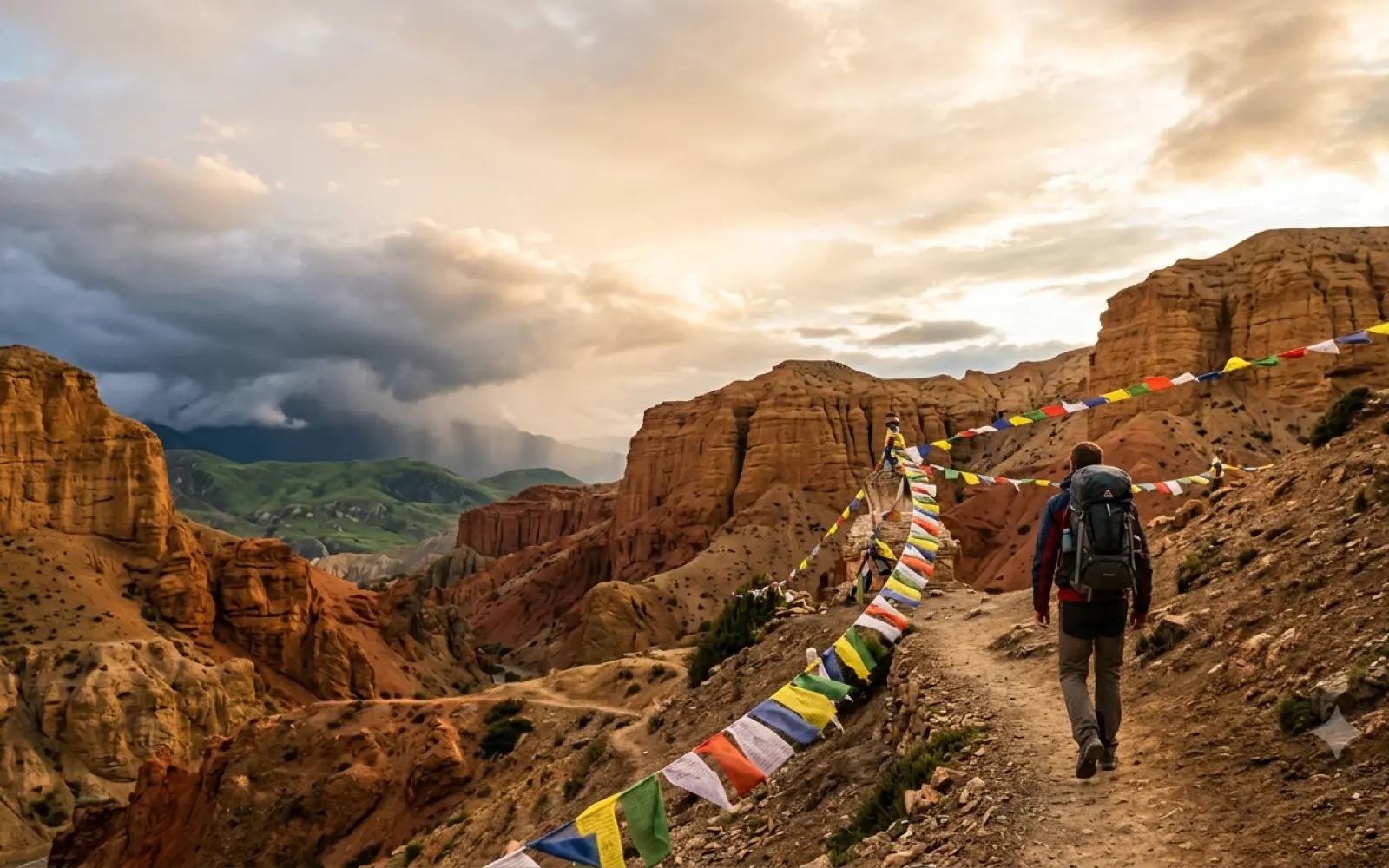
Most trekking advice tells you to avoid Nepal entirely between June and August. And for popular routes like Everest Base Camp or the classic Annapurna Base Camp trail, that advice holds up — trails turn to mud, leeches come out in force, and low cloud cover swallows the mountain views you came for. But monsoon isn't a dead season everywhere in the country. A handful of regions sit in the Himalayan "rain shadow" — areas where the mountains themselves block the monsoon clouds — and stay dry, clear, and fully walkable right through the wettest months of the year.
This guide breaks down exactly which treks still work in the rain, why the science behind rain-shadow geography makes them possible, what they cost in 2026, what to pack, and how to plan a monsoon trip that feels less like a compromise and more like a smarter way to see the Himalayas.
The rain shadow effect happens on the leeward side of a mountain range. Moisture-heavy monsoon winds sweep up from the Bay of Bengal and dump most of their rain on the southern slopes of the Himalaya — the mid-hills, the Kathmandu Valley, and lower trekking routes like Everest Base Camp and Langtang. By the time that same air crosses over the 7,000–8,000m peaks into the high valleys behind them, there's almost no moisture left to fall as rain.
That's why regions like Upper Mustang and Dolpo — both tucked behind the Annapurna and Dhaulagiri massifs — see only a fraction of the rainfall that soaks the greener hill country most visitors picture when they imagine Nepal. Instead of humid forest trails and swollen rivers, you get high desert plateaus, wind-carved canyons, and dry trails that barely change from one month to the next.
The trade-off is worth knowing about too. Rain-shadow treks tend to:
None of that makes them harder to enjoy — it just means monsoon trekking rewards a bit more planning than a spring or autumn trip to Poon Hill.
Often called Nepal's "Last Forbidden Kingdom" — it was closed to outside visitors until 1992 — Upper Mustang is the single most reliable monsoon destination in the country. The route runs north from Jomsom along the Kali Gandaki Valley into a landscape of red-and-ochre cliffs, wind-carved canyons, and centuries-old cave settlements, ending in Lo Manthang, the walled former capital with its whitewashed palace and monasteries. The Annapurna and Dhaulagiri ranges block the monsoon almost completely here, so trails stay dry and dusty even at the height of the rains in July and August.
Duration: typically 12–16 days. Max altitude: around 3,840m. Best for: trekkers who want the most dependable monsoon weather and a deep dive into Tibetan Buddhist culture.
One of the most remote trekking regions in Nepal, Dolpo starts with a flight to Nepalgunj and on to Juphal, then heads into a landscape of high desert plateaus, Bon monasteries, and the turquoise waters of Shey Phoksundo Lake. Like Mustang, Dolpo sits deep in the rain shadow, and the far-western, high-altitude terrain keeps it dry and scenic well into monsoon season. It's also one of the longer and more demanding options on this list, with sections above 5,000m.
Duration: roughly 18–25 days for the full circuit. Max altitude: above 5,000m at the high passes. Best for: experienced trekkers looking for Nepal's most remote and untouched terrain.
A shorter, slightly more accessible alternative to the full Upper Dolpo circuit, this route still reaches the striking turquoise waters of Shey Phoksundo Lake and passes through the Bon village of Ringmo, but without the extended high-altitude crossings of the upper route. It offers much of Dolpo's remote, rain-shadow character in a more manageable itinerary.
Duration: around 8–12 days. Max altitude: roughly 3,730m at the lake. Best for: trekkers who want a taste of Dolpo without committing to a full three-week expedition.
Tucked between the Annapurna and Manaslu ranges, Nar Phu is a narrow, restricted valley of traditional Tibetan-style villages that only opened to trekkers in the early 2000s. The trail climbs through a dramatic gorge before opening into high pasture and the twin villages of Nar and Phu, both still relatively untouched by tourism. Its high-altitude, rain-shadow position keeps trails dry, and it's often combined with a crossing into the Annapurna Circuit.
Duration: around 10–14 days. Max altitude: roughly 4,190m. Best for: trekkers who want remote valley culture alongside Annapurna-adjacent scenery.
The Annapurna Circuit as a whole gets wet during monsoon, but the Manang side of the route — beyond the town of Manang and up toward Thorong La Pass (5,416m) — sits in a rain shadow created by the Annapurna massif itself, and stays significantly drier than the lower, lusher sections near Besisahar. Trekkers who start from the Manang side, or fly into the region, can experience one of Nepal's classic high passes with far fewer crowds than during peak season.
Duration: varies by starting point; the Manang-to-Muktinath stretch alone takes about 4–6 days. Max altitude: 5,416m at Thorong La. Best for: trekkers chasing the iconic Thorong La crossing without autumn's crowds.
A restricted, sacred valley near the Manaslu region, Tsum Valley sees noticeably less rainfall than the lower Manaslu approach thanks to its position further behind the main Himalayan barrier. Known as the "Hidden Valley of Happiness," it's dotted with centuries-old monasteries like Mu Gompa and Rachen Gompa and traditional Tibetan-influenced villages that stay quiet and walkable through the summer months.
Duration: typically 15–18 days when combined with the Manaslu approach. Max altitude: around 3,700m. Best for: trekkers who want deep cultural and monastic immersion during monsoon.
The lower Manaslu trail through the Budhi Gandaki valley gets a full dose of monsoon rain, but the upper sections beyond Samagaon and toward Larkya La Pass sit at higher, drier altitude behind the Manaslu massif. Trekkers with flexible timing sometimes combine a wetter lower approach with a considerably drier upper circuit, making it a partial rather than full monsoon option.
Duration: 14–18 days for the full circuit. Max altitude: 5,106m at Larkya La. Best for: trekkers willing to accept wetter conditions low down in exchange for classic Manaslu scenery up high.
Home to Nepal's only hunting reserve, Dhorpatan sits in a lesser-known rain-shadow pocket west of the Annapurna and Dhaulagiri ranges. The trek passes through rhododendron forest, high pasture, and Magar and Tibetan settlements with far fewer trekkers than almost anywhere else in the country, monsoon or not.
Duration: around 10–14 days. Max altitude: roughly 3,700m. Best for: trekkers who want an off-the-beaten-path monsoon route with genuine solitude.
A far-western, high-altitude valley close to the Tibetan border, Limi Valley is one of the least-visited rain-shadow regions in Nepal. The trek passes through remote Tibetan-influenced villages, monasteries, and high pastureland, with a dry climate similar to Mustang and Dolpo but with a fraction of the (already low) trekker traffic those regions see.
Duration: around 18–20 days. Max altitude: above 4,500m. Best for: trekkers seeking the most remote, least-crowded monsoon trek in the country.
For those with a shorter window, Mohare Danda in the Annapurna foothills offers a moderate, ridge-top trek with wide Himalayan views and lower overall rainfall exposure than deeper Annapurna routes. It's not a true rain-shadow trek, but its shorter duration and community-lodge trail make it a manageable monsoon option for trekkers without two or three weeks to spare.
Duration: around 5–7 days. Max altitude: roughly 3,300m. Best for: trekkers wanting a shorter, moderate monsoon trek without heading into the far rain-shadow regions.
| Trek | Duration | Max Altitude | Region | Rain-Shadow Level | Permit Type |
|---|---|---|---|---|---|
| Upper Mustang | 12–16 days | 3,840m | Mustang | Very High | Restricted Area Permit |
| Upper Dolpo | 18–25 days | 5,000m+ | Dolpo | Very High | Restricted Area Permit |
| Lower Dolpo | 8–12 days | 3,730m | Dolpo | Very High | Restricted Area Permit |
| Nar Phu Valley | 10–14 days | 4,190m | Manang | High | Restricted Area Permit |
| Annapurna Circuit (Manang side) | 4–6 days (partial) | 5,416m | Annapurna | Moderate–High | ACAP + TIMS |
| Tsum Valley | 15–18 days | 3,700m | Gorkha | High | Restricted Area Permit |
| Manaslu Circuit (upper) | 14–18 days | 5,106m | Gorkha/Manang | Moderate (upper only) | Restricted Area Permit |
| Dhorpatan | 10–14 days | 3,700m | Baglung/Rukum | High | Restricted Area Permit |
| Limi Valley | 18–20 days | 4,500m+ | Humla | Very High | Restricted Area Permit |
| Mohare Danda | 5–7 days | 3,300m | Annapurna foothills | Low–Moderate | ACAP + TIMS |
| Trek | Difficulty | Fitness Level Needed | Prior Trekking Experience |
|---|---|---|---|
| Mohare Danda | Easy–Moderate | Basic fitness | Not required |
| Upper Mustang | Moderate | Good fitness | Recommended |
| Nar Phu Valley | Moderate–Challenging | Good fitness | Recommended |
| Tsum Valley | Moderate–Challenging | Good fitness | Recommended |
| Annapurna Circuit (Manang side) | Challenging | High-altitude fitness | Recommended |
| Lower Dolpo | Challenging | High-altitude fitness | Recommended |
| Manaslu Circuit | Challenging | High-altitude fitness | Required |
| Dhorpatan | Challenging | High-altitude fitness | Recommended |
| Upper Dolpo | Very Challenging | Excellent fitness | Required |
| Limi Valley | Very Challenging | Excellent fitness | Required |
While this guide is built around trekking during the June–September monsoon window, it's worth understanding how 2026's seasons line up so you can choose the right month for your specific route:
For a 2026 monsoon trip specifically, late June through early September remains the sweet spot — dry in the rain-shadow zones, with approach routes still passable before the heaviest late-monsoon rains build up in the lower valleys.
Clothing
Gear
Documents
Extras
Nepal's restricted-area permit system changed significantly in 2026, and it's worth knowing the current numbers before you budget a trip.
Restricted Area Permits (2026 rates):
Other permits and fees:
Guide and porter costs:
Approximate total package costs (2026, per person, guided, all-inclusive):
These ranges include permits, guide and porter fees, teahouse accommodation, and most meals, but exclude international flights, travel insurance, and personal gear. Prices vary by agency, group size, and exact itinerary, so treat these as planning estimates rather than fixed quotes.
1. Is monsoon really a good time to trek in Nepal? Yes, if you choose the right region. Rain-shadow areas like Upper Mustang, Dolpo, Nar Phu, and Limi Valley stay dry and clear through the monsoon months, even though lower-altitude, non-rain-shadow treks get heavy rain during the same period.
2. What months count as monsoon season in Nepal? Monsoon generally runs from June through early September, with the heaviest rainfall typically in July and August.
3. Which trek is the most reliable for dry monsoon weather? Upper Mustang is generally considered the most consistently dry monsoon destination, thanks to its position deep behind the Annapurna and Dhaulagiri ranges.
4. Do I need a guide for these treks? Yes. A licensed guide through a registered agency is legally required for all restricted-area treks, and is now required nationwide for foreign trekkers on non-restricted routes as well.
5. Can solo trekkers get restricted-area permits in 2026? Yes. A March 2026 rule change now allows solo trekkers to obtain restricted-area permits, though the requirement to trek with a licensed guide through a registered agency still applies.
6. How much does the Upper Mustang permit cost in 2026? As of the March 2026 rule change, Upper Mustang's restricted-area permit costs USD 50 per person per day, replacing the previous flat USD 500 fee for the first 10 days.
7. Are teahouses open during monsoon season? Yes, most teahouses on these routes operate year-round, though availability and services may be more limited than during peak spring and autumn seasons.
8. Is monsoon trekking cheaper than spring or autumn? Generally, yes. Lower demand often means better teahouse availability, more flexible guide scheduling, and occasionally lower package prices, particularly outside the rain-shadow "peak" months of September–November.
9. What's the biggest risk on a monsoon trek, even in a rain-shadow region? Flight delays are the most common issue, since many of these treks start with a mountain flight, and monsoon cloud cover over lower routes can cause cancellations or delays even when your destination region is dry.
10. Do rain-shadow treks still have any rain at all? Yes, occasionally — rain-shadow doesn't mean zero rain, just significantly less than the surrounding regions. Light showers can still occur, so waterproof gear is still worth packing.
11. Are leeches a problem on these routes? Leeches are mainly an issue on lower-altitude, wetter approach trails rather than in the dry, high-altitude rain-shadow zones themselves. Gaiters, insect repellent, and salt are the standard defenses.
12. Which of these treks is best for a first-time high-altitude trekker? Mohare Danda is the gentlest option on this list. Among the true rain-shadow treks, Upper Mustang is generally considered the most approachable for trekkers with some but not extensive high-altitude experience.
13. How long in advance should I book a 2026 monsoon trek? For popular routes like Upper Mustang, booking 4–8 weeks ahead is generally sufficient during monsoon, since demand is lower than in autumn — though permit processing and flight availability can still take time.
14. Do children or older travelers do well on these treks? Shorter, lower-altitude options like Mohare Danda are more suitable for families or older travelers. The higher-altitude restricted-area treks are generally better suited to trekkers with prior experience.
15. What vaccinations or health preparations are recommended? Standard travel vaccinations (as advised by a travel clinic), a basic altitude-sickness plan, and comprehensive travel insurance covering high-altitude trekking and emergency evacuation are all strongly recommended.
16. Can these treks be combined with each other? Yes — Nar Phu Valley is often combined with the Annapurna Circuit, and Tsum Valley is frequently combined with the Manaslu Circuit, since their trailheads and permits overlap.
17. Is travel insurance mandatory? It isn't always legally mandatory, but it is strongly recommended and often required by trekking agencies, particularly for high-altitude, restricted-area routes where emergency evacuation can be costly.
18. What's the minimum group size for restricted-area permits? Most restricted areas require a minimum of two trekkers per group, though solo trekkers can now obtain permits as of the March 2026 rule change, provided they still trek with a licensed guide.
19. Will I still get mountain views during monsoon in these regions? Yes — rain-shadow regions typically offer clear skies for most of the monsoon period, since the same mountain barrier that blocks rain also blocks the heavy cloud cover that obscures views elsewhere in the country during these months.
20. Which trek offers the best value for a first monsoon trip? Upper Mustang offers the best balance of reliability, cultural depth, and manageable duration for trekkers trying monsoon trekking for the first time.
Monsoon doesn't have to mean the end of trekking season in Nepal — it just means trading a handful of popular routes for some of the country's most remote, culturally rich, and dependably dry alternatives. From the desert cliffs of Upper Mustang to the turquoise waters of Shey Phoksundo Lake in Dolpo, rain-shadow trekking offers a version of the Himalayas that most visitors never see: quieter trails, deeper cultural immersion, and landscapes that stay clear and walkable while the rest of the country is under cloud cover. With the right region, the right permits, and the right preparation, June through September can be one of the smartest windows to trek in Nepal — not the one to avoid.
Explore Holiday Nepal specializes in exactly this kind of trip — rain-shadow treks that work when the rest of the country is under monsoon cloud cover. From permit processing and licensed guides to comfortable teahouse arrangements and flexible itineraries built around 2026's flight and weather patterns, the team handles the logistics so you can focus on the trek itself. If Upper Mustang, Dolpo, Nar Phu Valley, or any other route on this list has caught your attention, get in touch with Explore Holiday Nepal to start planning a monsoon trek that actually works in the rain.


 (34)
(34) 