 Honey Hunting Tour in Ludi: Nepal's Most Thrilling Cultural Adventure
Deep in the hills of central Nepal, where terraced fields cascade down mountainsides and the Annapurna range dominates the northern horizon, exists a tradition so ancient, so dangerous, and so visually spectacular that it seems to belong to another era entirely. The Honey Hunting Tour in Ludi offers travelers something increasingly rare in our modern world: a genuine adventure that hasn't been sanitized, packaged, or stripped of its authentic character.
This isn't your typical Nepal experience. While thousands of trekkers head to famous routes like the Everest Base Camp Trek or Annapurna Circuit Trek, the honey hunting tradition in Ludi remains relatively unknown—a closely guarded cultural treasure practiced by the Gurung community for centuries. The Honey Hunting Tour in Ludi provides access to this extraordinary world, where men still risk their lives scaling sheer cliffs to harvest wild honey from the world's largest honeybee species.
The star of this story isn't actually human—it's Apis laboriosa, the giant Himalayan honeybee. These remarkable insects represent the world's largest honeybee species, with workers measuring up to 3 centimeters in length. Unlike domestic honeybees that happily inhabit wooden boxes, Apis laboriosa builds massive exposed hives on sheer cliff faces, often hundreds of feet above the ground, in locations that seem designed to deter any creature foolish enough to attempt reaching them.
These bees don't choose cliff locations randomly. The exposed rock faces provide protection from predators, temperature regulation, and ideal conditions for their colonies. A single hive can measure up to 1.5 meters in diameter and contain tens of thousands of bees producing honey with unique properties. The higher altitude hives—some located at elevations exceeding 2,500 meters—produce what locals call "mad honey" or hallucinogenic honey, which contains grayanotoxins from rhododendron nectar and has been used traditionally for medicinal purposes and ritualistic practices.
The bees themselves are formidable defenders of their nests. Their stings pack significantly more venom than common honeybees, and unlike some bee species that die after stinging, Apis laboriosa can sting repeatedly. Swarms of angry giant bees represent a genuine threat to anyone attempting to harvest their honey, which is precisely why this tradition requires such extraordinary skill, courage, and respect for the bees.
The Gurung community of central Nepal has maintained the honey hunting tradition for centuries, passing down knowledge, techniques, and spiritual practices from generation to generation. The Gurung people, one of Nepal's many indigenous ethnic groups, have historically inhabited the mid-hills region where these giant honeybees establish their colonies.
What makes the Gurung honey hunters special isn't just their climbing ability or bravery—it's their comprehensive understanding of bee behavior, cliff geography, weather patterns, and the spiritual dimensions they believe surround this dangerous practice. Master honey hunters, some now in their 60s and 70s, began learning the craft as young boys, observing their fathers and uncles, gradually taking on more responsibility until they could lead hunts themselves.
The tradition faces uncertain futures in many areas as younger generations leave villages for urban opportunities, seeing less appeal in a dangerous practice that yields modest financial returns. This demographic shift makes experiencing the honey hunt now particularly significant—you're witnessing a cultural tradition that might not survive another generation in its authentic form.
For the Gurung community, honey hunting transcends simple food gathering—it's a deeply spiritual practice interwoven with animist beliefs, Hindu traditions, and respect for natural forces. Before any hunt, elaborate ceremonies honor the cliff spirits, the bees, and various deities believed to control the honey hunters' fate.
A shaman or village elder typically performs these ceremonies, making offerings of rice, flowers, and sometimes sacrificing a chicken or goat. Participants abstain from certain foods, observe behavioral restrictions, and maintain respectful attitudes. The ceremonies ask permission from the spirits to harvest honey, seek protection for the hunters, and express gratitude for the bees' gifts.
These aren't empty rituals performed for tourists—they represent genuine belief systems that have governed these communities for centuries. The spiritual preparation is considered as important as the physical preparation, perhaps more so. Stories abound of hunts that went tragically wrong when proper ceremonies weren't performed, serving as cautionary reminders of the forces involved.
The honey hunting season typically runs from April to June and again from October to November, when the hives reach their maximum size and honey production peaks. These timing windows also coincide with more favorable weather conditions—crucial when spending hours suspended on cliff faces.
Days before the actual hunt, scouts identify promising cliffs and assess hive locations. They examine access routes, evaluate rope attachment points, study bee activity patterns, and monitor weather forecasts. This reconnaissance proves crucial to planning the safest approach, though "safe" remains a relative term when discussing activities that involve dangling from rope ladders hundreds of feet above the ground while being attacked by thousands of giant bees.
The rope ladders used represent marvels of traditional engineering. Woven from bamboo and local forest fibers, these ladders must be strong enough to support multiple people's weight while flexible enough to navigate around cliff irregularities. Creating and maintaining these ladders requires specialized knowledge, with master craftsmen examining every rung and connection point before declaring a ladder safe for use.
Team members gather to assemble equipment: bamboo poles (some extending 3-4 meters for reaching distant hives), collection baskets, protective clothing (traditionally just simple cloth, though some hunters now wear face nets), fire materials for creating smoke, and offerings for the pre-hunt ceremony. The atmosphere during these preparations combines excitement, nervous energy, and solemn respect for the dangerous undertaking ahead.
Dawn typically marks the beginning of the hunt. The ceremony performed, the team approaches the cliff base with equipment. The master hunter—always the most experienced and skilled climber—prepares to descend (or sometimes ascend, depending on cliff configuration) to the hives.
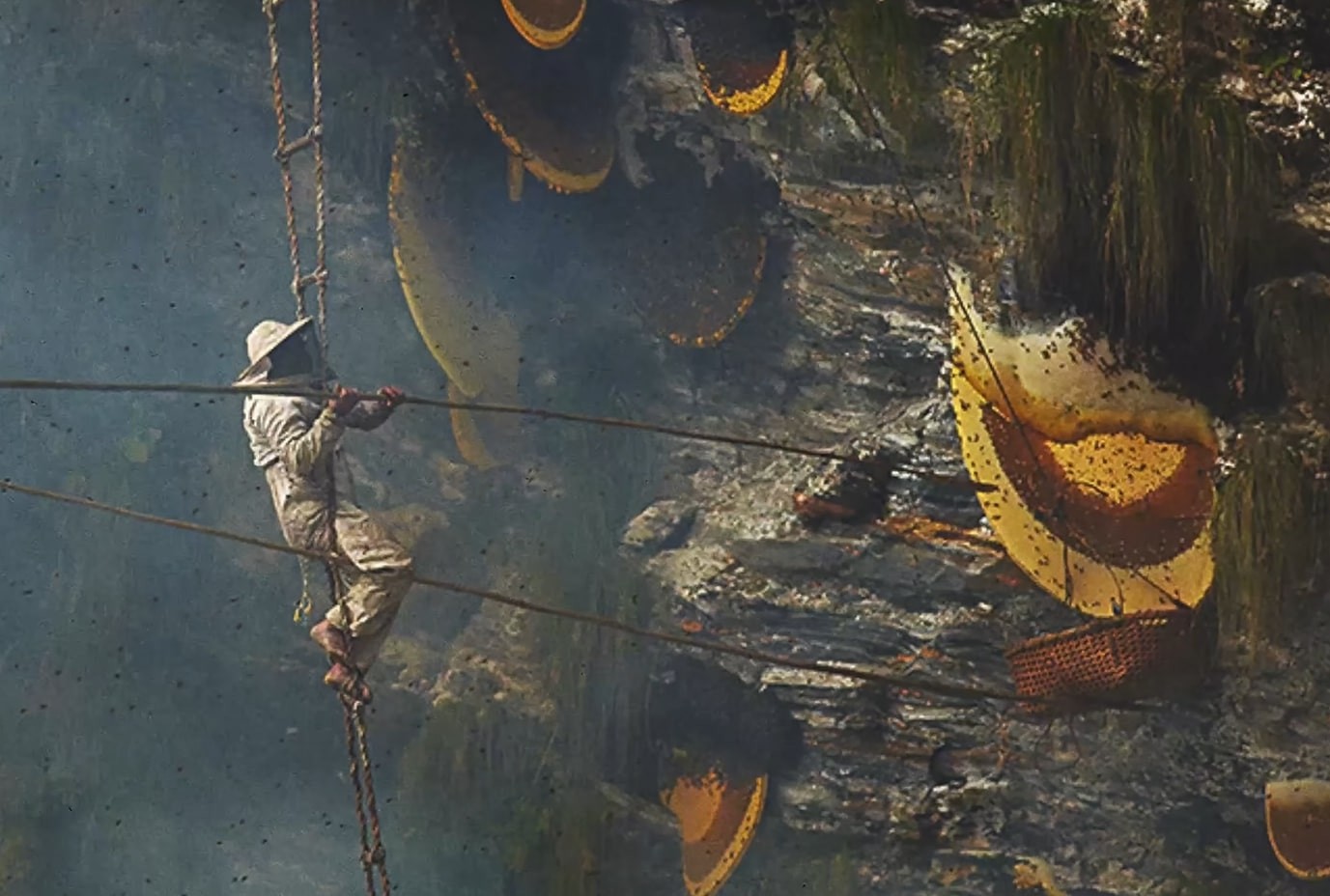
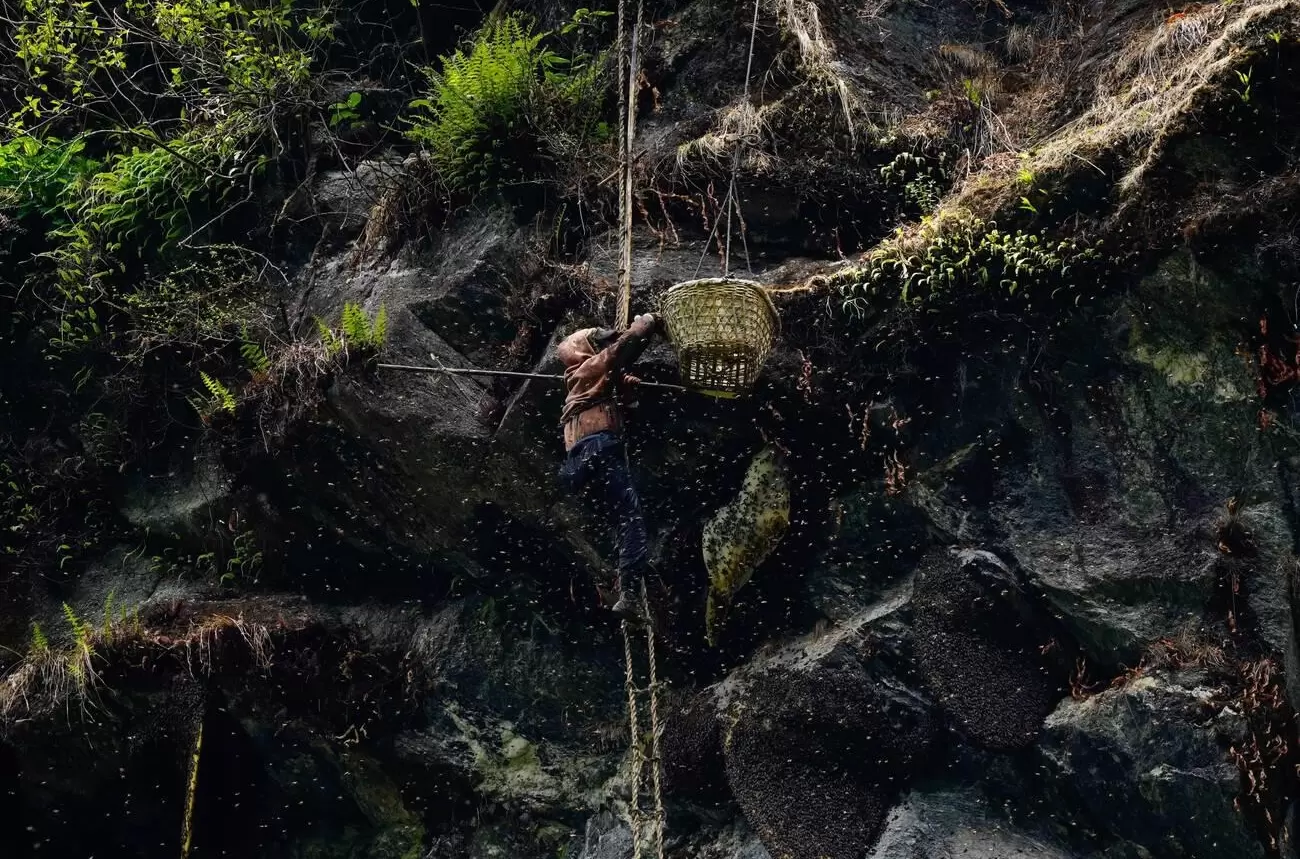
Watching a master honey hunter work is witnessing human courage and skill at extraordinary levels. Using the bamboo rope ladder, he descends the cliff face with remarkable confidence, his weight distributed across various attachment points. Team members above manage the ropes, maintaining tension and responding to the master hunter's shouted instructions.
As the hunter approaches the hive, he ignites a bundle of green leaves and branches, creating thick smoke that drives the bees away from their nest. This smoke doesn't make the bees passive—it triggers their survival instincts, making them gorge on honey (preparing to abandon the nest if necessary) and become somewhat less aggressive. "Somewhat" being the operative word, as hundreds of angry giant bees still swarm around the hunter, stinging exposed skin repeatedly.
The actual honey harvesting happens quickly. Using a long bamboo pole with a basket attached, the hunter breaks pieces of honeycomb free from the cliff, catching them in the basket while maintaining his precarious position on the ladder. A single false move—a broken rope, a moment of dizziness from bee stings, a gust of wind—could prove fatal. The hunters are acutely aware of this reality, having likely known colleagues who died or were seriously injured during hunts.
The honeycomb, heavy with honey and bee larvae, is lowered in baskets to team members below. Once sufficient honey has been collected (or the bees become too aggressive to continue safely), the master hunter signals for his team to pull him back up. The entire process might take 2-4 hours of intense, focused danger.
The successful hunt's conclusion brings palpable relief and celebration. The honey is distributed among team members and the broader community according to traditional protocols, with shares designated for the master hunter, his assistants, the village elders, and various community needs. The honey serves multiple purposes: food, traditional medicine, trade goods, and offerings for religious ceremonies.
Fresh honeycomb eaten directly offers a taste unlike any commercially available honey. The flavor profile depends on the flowers the bees visited—rhododendron honey tastes distinctly different from honey gathered from other sources, with complex floral notes and sometimes a slight intoxicating quality from the grayanotoxins present in higher-altitude honey.
The celebration also includes storytelling, with hunters recounting close calls, funny moments, and particularly dangerous maneuvers from the day's hunt. These stories reinforce the tradition's oral history, teaching younger observers while entertaining the community. Traditional millet beer (tongba) or homemade raksi (distilled spirits) typically flow freely during these celebrations.
Ludi sits in the Lamjung district of central Nepal, positioned perfectly for honey hunting tourism. The area features numerous cliff faces where giant honeybees establish colonies, traditional Gurung villages maintaining authentic lifestyles, and spectacular mountain scenery dominated by the Annapurna and Dhaulagiri ranges.
The trek to honey hunting sites takes travelers through quintessential middle-hills Nepal landscape: terraced rice fields creating geometric patterns across hillsides, rhododendron forests that explode with color during spring, small villages where life proceeds much as it has for centuries, and trails offering increasingly dramatic mountain views as you gain elevation.
Unlike the crowded trails of popular routes like the Ghorepani Poon Hill Trek or Mardi Himal Trek, the paths around Ludi remain relatively quiet. You're more likely to encounter local farmers herding goats or carrying goods than other trekking groups. This isolation enhances the authenticity of the experience—you're visiting a living culture, not a tourism performance.
The Gurung villages around Ludi provide as much attraction as the honey hunting itself. These communities maintain traditional lifestyles increasingly rare in modernizing Nepal. Stone houses with slate roofs cluster on hillsides, smoke rising from cooking fires, elderly people sitting in doorways watching life pass by, children playing in village squares, and livestock wandering freely through narrow lanes.
Village hospitality is legendary. Guests are welcomed into homes, offered tea or millet beer, and included in family activities. The Gurung are naturally warm and curious people, eager to share their culture while learning about visitors' backgrounds. These interactions—sharing meals around the hearth, watching women weave traditional cloth, listening to elders recount village history—often prove as memorable as the honey hunting itself.
The villages also feature traditional Buddhist and animist shrines, terraced gardens growing vegetables and medicinal plants, water-powered mills grinding grain, and other elements of sustainable mountain agriculture. Observing how communities function largely independently of modern infrastructure provides valuable perspective on self-sufficiency and traditional ecological knowledge.
The honey hunting seasons (spring and autumn) dictate optimal visiting times. Spring (April-May) offers the advantage of rhododendron forests in full bloom, creating spectacular displays of red, pink, and white flowers covering entire hillsides. The weather is generally stable, though afternoon clouds can obscure mountain views. This season produces the famous "mad honey" from rhododendrons.
Autumn (October-November) provides the year's clearest mountain views, with crisp air and stable weather creating perfect trekking conditions. Temperatures are comfortable during the day, though nights can be cold. The post-monsoon landscape glows green from recent rains, and the autumn harvest season brings festivals and celebrations to villages.
Summer monsoon season (June-September) sees limited honey hunting due to rain, slippery cliffs, and bees' reduced activity. Winter (December-March) is generally not hunting season, as bees are less active and harsh weather makes cliff access dangerous.
The Gurung community possesses rich musical and dance traditions deeply connected to their cultural identity. During village celebrations and special occasions, traditional performances showcase instruments like the madal (hand drum), damphu (circular drum), and bansuri (bamboo flute). The rhythms and melodies, passed down orally through generations, tell stories of daily life, spiritual beliefs, and historical events.
The sorathi dance, performed during festivals and celebrations, involves dancers moving in circular patterns while singing traditional songs. The lyrics often relate to honey hunting, mountain life, changing seasons, and relationships. Visitors who arrive during festival times might witness full-scale cultural performances involving entire villages.
Honey hunting tours often include cultural evenings where local musicians and dancers perform specifically for guests. While these performances are organized for tourists, they represent genuine traditions rather than manufactured entertainment. The performers are community members who grew up learning these art forms and take pride in sharing them with outsiders.
Gurung cuisine reflects the community's mountain environment and agricultural practices. Dal bhat (lentils and rice) forms the foundation, but local variations include distinctive touches: gundruk (fermented leafy greens), dhindo (millet or cornmeal porridge), and various chutneys made from local ingredients like timur (Szechuan pepper) and jimbu (Himalayan herb).
Fresh honey naturally features prominently during honey hunting tours. Locals consume it directly, mix it into tea, use it in cooking, and offer it to guests as a special treat. Experiencing freshly harvested wild honey—still in the comb, perhaps with bee larvae visible—represents a unique culinary adventure quite different from store-bought honey.
Tongba, a millet beer served in a wooden or bamboo container with hot water poured over fermented millet, is the traditional beverage for celebrations and hospitality. Drinking tongba follows specific customs: the host serves it, the first drink is relatively weak (as the water extracts alcohol from the millet), subsequent refills become stronger, and the container is shared among participants using bamboo straws.
Gurung women are renowned for their weaving skills, producing distinctive textiles featuring geometric patterns and color combinations that identify their ethnic group. Watching weavers work on back-strap looms—an ancient technology requiring remarkable skill—provides insight into the time and effort invested in creating traditional clothing.
Bamboo craft represents another important skill set. Beyond rope ladders for honey hunting, bamboo is fashioned into baskets, containers, mats, musical instruments, and countless household items. The knowledge required to select appropriate bamboo, process it correctly, and craft durable functional objects reflects generations of accumulated expertise.
Some villages maintain blacksmith traditions, producing the khukuri knives famously associated with Gurkha soldiers (many of whom are Gurung). Watching a blacksmith heat, hammer, and shape metal using techniques unchanged for centuries demonstrates traditional craftsmanship's enduring relevance.
While the Honey Hunting Tour in Ludi offers excellent experiences, Nepal has other locations where this tradition continues. The Honey Hunting Tour in Lamjung, Siurikhola provides similar cultural encounters in a slightly different geographic setting within the same district.
Siurikhola tends to attract slightly more visitors than Ludi, meaning more developed tourism infrastructure but potentially less intimate cultural exchanges. The cliffs and hunting techniques remain essentially identical, as both locations are inhabited by Gurung communities maintaining the same traditions.
The Honey Hunting in Ghanpokhara and Ghalegaun represents another option for experiencing this tradition. Ghalegaun has developed somewhat more organized homestay networks and community-based tourism initiatives, offering more comfortable accommodations and structured cultural programs.
The trade-off is authenticity versus comfort. Ludi remains more rustic and less influenced by tourism development, providing rawer, more authentic experiences. Ghalegaun offers better facilities, easier logistics, and more predictable experiences—appealing to travelers prioritizing comfort or those with limited time.
The honey hunting tour requires moderate fitness levels. The trekking involved isn't as demanding as high-altitude routes like the Annapurna Base Camp Trek or Langtang Valley Trek, as elevations remain relatively low (typically 1,000-2,500 meters). However, you'll be walking several hours daily on sometimes steep trails.
Participants don't need climbing skills or previous honey hunting experience. The actual cliff work is performed by trained local hunters—visitors observe from safe vantage points. However, reaching viewpoints might involve some scrambling over rocks or navigating rough terrain.
More important than physical fitness is mental comfort with heights and potentially intense situations. Watching someone dangle from rope ladders hundreds of feet above ground while being attacked by bees isn't for everyone. Some visitors find the experience exhilarating, others find it stress-inducing.
Essential items include:
Experiencing honey hunting tourism carries responsibility. This is someone's culture, livelihood, and dangerous profession—not a performance staged for entertainment. Maintaining respectful attitudes and following your guide's instructions ensures positive interactions and supports sustainable tourism development.
Photography requires consideration. Always ask permission before photographing people, especially during ceremonies or in villages. Some rituals or moments may be inappropriate for photography. The actual hunt is generally acceptable to photograph, but follow your guide's directions about positioning and behavior to avoid interfering with the hunters' dangerous work.
Compensation for honey hunting demonstrations should be fair and agreed upon beforehand through your tour operator. The relatively modest cash income honey hunting provides makes it economically challenging to justify compared to other livelihood options. Tourism can provide supplementary income that helps keep the tradition alive, but only if structured fairly.
Many honey hunting tours incorporate homestays, meals, and cultural performances that directly benefit local communities. This community-based tourism model ensures that economic benefits from tourism flow to villagers rather than being captured entirely by external operators.
Consider bringing small gifts for host families: school supplies for children, solar lights for homes without electricity, basic medicines for village health posts, or books for community centers. Discuss appropriate gifts with your tour operator beforehand to ensure they're culturally appropriate and genuinely useful.
Purchasing locally made handicrafts—woven textiles, bamboo products, knitted items—provides direct income to artisans while giving you authentic souvenirs with genuine stories behind them.
The Ludi region's location makes combining honey hunting with other adventures logical. The Annapurna Base Camp Short Trek could precede or follow honey hunting, offering mountain vistas and high-altitude trekking contrasting nicely with the cultural focus of honey hunting.
The Royal Trek, passing through Gurung villages with excellent Annapurna views, provides similar cultural encounters in a more structured trekking format. The Panchase Trek offers another accessible option with beautiful scenery and cultural experiences.
For those wanting extended adventures, the full Annapurna Circuit Trek or Manaslu Circuit Trek could incorporate detours for honey hunting, creating comprehensive experiences combining high mountain trekking with cultural immersion.
The Kathmandu Pokhara Chitwan Tour could bookend a honey hunting experience, providing contrasts between urban culture, mountain scenery, wildlife encounters, and village traditions. This creates a comprehensive Nepal experience showcasing the country's remarkable diversity.
Similarly, the Kathmandu Pokhara Lumbini Chitwan Tour adds spiritual dimensions through visiting Buddha's birthplace, creating a journey encompassing cultural, spiritual, natural, and wildlife aspects of Nepal.
Traditional honey hunting faces multiple pressures threatening its continuation. Younger generations increasingly prefer urban employment over dangerous village traditions. Climate change affects bee populations and flowering patterns. Modern beekeeping offers safer alternatives for honey production. The knowledge transfer from master hunters to apprentices has slowed as fewer young people commit to learning the practice.
Tourism presents both opportunities and risks. Done responsibly, tourism can provide economic incentives for maintaining traditions, generate pride in cultural heritage among younger community members, and create documentation of practices that might otherwise disappear. However, poorly managed tourism might commodify and degrade authentic traditions, create dependency on external income, or pressure communities to perform hunts regardless of optimal timing or safety conditions.
Travelers choosing honey hunting experiences play crucial roles in this tradition's future. Selecting operators committed to fair community compensation, environmental protection, and cultural respect sends market signals supporting sustainable tourism models. Engaging respectfully with communities, asking thoughtful questions, and genuinely appreciating the cultural significance (rather than just seeking adrenaline thrills or Instagram content) contributes to positive outcomes.
Spreading awareness about this tradition through word-of-mouth, social media, and travel writing helps generate interest that can sustain community-based tourism initiatives. However, this awareness must be balanced against the risk of over-tourism overwhelming small villages unequipped to handle large visitor numbers.
In an increasingly homogenized world where traditional practices are abandoned for modern alternatives, experiencing something as authentic, dangerous, and culturally significant as honey hunting feels almost revolutionary. This isn't a staged performance or a sanitized cultural show—it's a real tradition practiced by real people who genuinely risk their lives for honey that genuinely sustains their communities.
The Honey Hunting Tour in Ludi offers something rare: a chance to witness extraordinary human courage, connect with a living tradition thousands of years old, engage meaningfully with indigenous communities, and experience Nepal beyond the standard tourist circuits.
Whether you're an adventure seeker looking for experiences that genuinely push boundaries, a cultural enthusiast wanting deep immersion in authentic traditions, a photographer seeking unique subjects, or simply someone who appreciates rare and remarkable human endeavors, honey hunting delivers experiences you'll carry with you forever.
The tradition faces uncertain futures, making experiencing it now particularly significant. You're not just a tourist consuming an experience—you're a witness to cultural heritage, a participant in sustainable tourism models, and potentially an advocate who'll help ensure these traditions receive the respect and support they deserve.
The cliffs of Ludi, the giant Himalayan honeybees, and the brave Gurung hunters await. This is Nepal beyond the trekking trails, beyond the tourist cafes, beyond the comfortable and familiar. This is Nepal at its most authentic, most challenging, and most rewarding.
Upon your arrival at Tribhuvan International Airport in Kathmandu, you will be greeted by a representative who will assist with your transfer to your hotel. As you navigate through the vibrant streets of Kathmandu, you’ll catch your first glimpses of the city’s unique blend of ancient architecture and modern hustle. Once checked in, you can take some time to relax and refresh after your journey. In the evening, enjoy a welcome dinner at a traditional Nepali restaurant where you can sample authentic cuisine and get acquainted with your fellow travelers and guide. A brief orientation session will also provide an overview of the upcoming adventure.
Your adventure begins with an early morning drive from the bustling city of Kathmandu to the tranquil village of Nadi. The journey covers approximately 185 kilometers and takes about 6-7 hours. As you leave behind the urban sprawl, you'll be greeted by the picturesque countryside, dotted with terraced fields, quaint villages, and lush green hills. The drive offers splendid views of the Trishuli River and the majestic Himalayan ranges in the distance.
You'll pass through various small towns and markets, providing a glimpse of the local lifestyle and culture. A stop for lunch at a roadside restaurant allows you to savor some authentic Nepali cuisine. As you approach Nadi, the landscape becomes more rugged, with winding roads and dense forests. Upon arrival in Nadi, you'll settle into a local guesthouse. In the evening, enjoy a warm welcome from the villagers and a traditional dinner, preparing you for the trekking adventure ahead.
After a hearty breakfast, you'll set off on foot towards Ludi. The trek, approximately 5-6 hours, takes you through a diverse terrain of forests, terraced fields, and traditional villages. The trail winds through rhododendron and pine forests, offering occasional glimpses of snow-capped peaks.
As you ascend, the air becomes fresher, and the sounds of nature more pronounced. The route is dotted with small streams and waterfalls, providing perfect spots for short breaks and photo opportunities. Along the way, you'll encounter local farmers and herders, giving you a chance to learn about their daily lives and unique traditions.
By mid-afternoon, you'll reach Ludi, a picturesque village known for its honey hunting heritage. Here, you'll be welcomed by the local Gurung community and have the opportunity to explore the village. In the evening, enjoy a traditional meal prepared by your hosts, and learn more about the honey hunting process in anticipation of the next day's activities.
After breakfast, bid farewell to the hospitable villagers of Ludi as you begin your trek towards Besisahar. The journey, which takes approximately 6-7 hours, offers a descent through the scenic trails you ascended earlier. The route takes you through lush forests, alongside bubbling streams, and past terraced fields that reflect the hard work of the local farmers.
As you approach Besisahar, the landscape gradually transitions to a more populated area with larger villages and more infrastructure. Besisahar, the administrative center of the Lamjung district, marks the end of your trekking adventure. Upon arrival, you'll check into a comfortable guesthouse where you can rest and reflect on your journey. In the evening, take a stroll around the town, explore the local markets, and enjoy a final dinner with your trekking companions.
Your final full day in Nepal begins with a drive back to Kathmandu. The journey, which takes about 6-7 hours, offers a chance to relax and reminisce about the past few days’ adventures. The scenic drive takes you through the heart of the countryside, with opportunities to stop for breaks and enjoy the last views of the majestic landscapes. As you re-enter the bustling city of Kathmandu, you’ll be transferred to your hotel for your last night in Nepal. In the evening, enjoy a farewell dinner at a local restaurant, sharing memories and highlights of your trip with your fellow travelers.
Optional:
You might choose to visit some of Kathmandu's famous cultural sites, such as Swayambhunath (the Monkey Temple), Boudhanath Stupa, or Durbar Square. Alternatively, you can indulge in some last-minute shopping for souvenirs or simply relax and unwind.
On your final day, enjoy a leisurely breakfast at your hotel and take some time to reflect on the incredible experiences of your Honey Hunting Tour. Depending on your flight schedule, You will be transferred to Tribhuvan International Airport for your departure. As you bid farewell to Nepal, take with you the memories of the breathtaking landscapes, the warmth and hospitality of the local communities, and the unique experience of honey hunting in Ludi. Safe travels, and we hope to welcome you back to Nepal soon!
Your Start Date is the day you land in Nepal, and your End Date is when you fly home.
If the set Honey Hunting Tour in Ludi group dates don’t suit your schedule, we can offer alternative dates upon request.
The Honey Hunting Tour in Ludi was an unforgettable experience. Watching skilled locals gather honey from the cliffs was both thrilling and awe-inspiring. Explore Holiday Nepal made the experience smooth with great guides and perfect organization.
The Honey Hunting Tour in Ludi was truly exhilarating. The local tradition of honey hunting was fascinating, and the scenery was stunning. Explore Holiday Nepal made the entire experience seamless and memorable with their excellent team.
Honey hunting is a traditional practice where locals harvest honey from wild beehives, often located on steep cliffs. This activity showcases the bravery and skill of honey hunters, who use age-old techniques to safely collect honey while engaging with their cultural heritage.
Ludi is a picturesque village in the Lamjung district of Nepal, known for its stunning landscapes and rich biodiversity. Nestled in the hills, Ludi offers a perfect setting for honey hunting and provides breathtaking views of the surrounding mountains and valleys.
Participants can expect to learn about traditional honey hunting techniques, watch the process of climbing cliffs to collect honey, and engage with local culture. The experience often includes discussions about the significance of honey in local customs, as well as the opportunity to taste the freshly harvested honey.
Yes, many tour operators offer tours that allow tourists to actively participate in honey hunting. This may include climbing with local hunters, learning the skills needed for the hunt, and experiencing the excitement of harvesting honey firsthand. Booking with a reputable operator is recommended for a safe and authentic experience.
In addition to honey hunting, visitors can enjoy trekking, birdwatching, and exploring the beautiful natural surroundings. Ludi offers opportunities to engage with local culture, visit nearby villages, and take in the stunning views of the Himalayas.
The best times for honey hunting in Ludi are generally from March to May and September to November. During these months, the weather is favorable, and the bee activity is high, making it safer and more productive for hunters.
While honey hunting involves some risks, such as climbing and potential bee stings, local honey hunters are experienced and use traditional methods to mitigate dangers. Participating under the guidance of local experts can enhance safety and provide a richer understanding of the practice.
Honey hunters typically use basic climbing gear such as ropes, ladders, and baskets for collection. They may also use smoke from burning materials to calm the bees, making the process safer. The methods and tools can vary depending on local customs and techniques.
To prepare for a honey hunting tour, wear sturdy shoes suitable for climbing and comfortable outdoor clothing. Bring a water bottle, sunscreen, and a camera to capture the experience. Being open to learning about local customs and traditions will enhance your overall adventure.
Accommodation options in Ludi generally include guesthouses and homestays, which provide a warm and welcoming environment. These options often allow visitors to experience local hospitality and traditional cuisine, with some places offering basic amenities.




 (34)
(34) 