Langtang Gosainkunda Trek
| Trip code | |
| Package name | Langtang Gosainkunda Trek |
| Duration | 15 |
| Max. elevation | 4620 m |
| Level | Moderate |
| Transportation | All ground transportation as per itinerary |
| Accomodation | Hotel in Kathmandu and Tea House / Lodge during the trek |
| Starts at | kathmandu |
| Ends at | kathmandu |
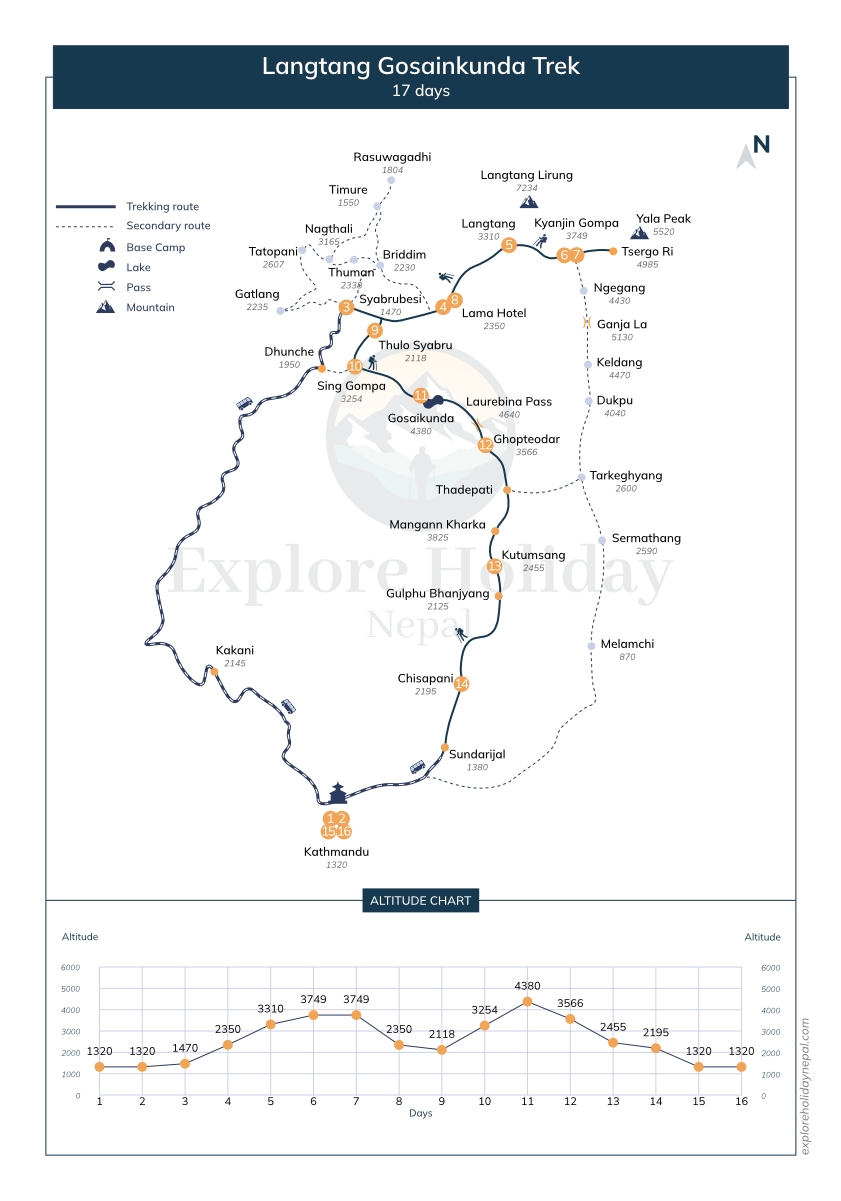
| Trip route | Kathmandu - Syabrubesi - Lama Hotel - Langtang Village - Kyanjin Gompa - Lama Hotel - Upper Syabru - Sing Gompa - Gosainkunda Lake - Ghopte Odar - Kutumsang - Chisapani - Sundarijal - Kathmandu |
| Cost | USD 905 per person |
Highlights
- Trek through the picturesque Langtang Valley, offering stunning views of the Langtang mountain range.
- Immerse yourself in the rich Tamang culture by visiting traditional villages and interacting with locals.
- Reach Kyanjin Gompa, a scenic village with a Buddhist monastery, and enjoy panoramic mountain views.
- Visit the sacred Gosaikunda Lake, a high-altitude alpine lake surrounded by snow-capped peaks.
- Explore the beautiful Helambu region, known for its charming villages and terraced fields.
- Trek through Langtang National Park, home to diverse flora and fauna, including the elusive red panda.
- Challenge yourself by crossing the Laurebina Pass to reach Gosaikunda, providing breathtaking views.
- Gosaikunda is considered a sacred pilgrimage site for Hindus, adding cultural and religious significance to the trek.
- Hike through enchanting rhododendron forests, particularly vibrant during the spring season.
- Stay in tea houses along the trail and savor local Tamang and Sherpa cuisine.
- Include the Tamang Heritage Trail for a more in-depth cultural experience with traditional Tamang villages.
- Enjoy panoramic views of the Langtang range from Cholangpati and stunning mountain views from Laurebina Pass.
- Experience diverse landscapes, including alpine meadows, rocky terrain, and high mountain passes.
- Keep an eye out for wildlife, including the red panda, Himalayan tahr, and various bird species.
- Capture breathtaking sunrise and sunset views over the Himalayan peaks.
Overview
 Langtang Gosaikunda Trek: Where Sacred Lakes Meet Himalayan Valleys
The first thing that hits you when you step off the bus in Syabrubesi isn't the mountain air or the sound of rushing rivers—it's the anticipation. I remember standing there with my backpack, staring up at the terraced hillsides disappearing into clouds, wondering what stories these valleys held. Two weeks later, I'd discover that the Langtang Gosainkunda Trek wasn't just about reaching destinations; it was about the moments between—the chai shared with locals, the sudden gasp when mountains reveal themselves, the silence at 4,380 meters beside a frozen sacred lake.
This trek changed something in me. Maybe it'll change something in you too.
Why Langtang Gosaikunda Deserves Your Attention
While everyone flocks to Everest Base Camp and Annapurna Circuit, the Langtang region quietly offers something those crowded trails can't—intimacy with the mountains. Destroyed by the devastating 2015 earthquake, the valley has rebuilt itself with remarkable resilience. Today, trekking here isn't just tourism; it's supporting communities that refused to let disaster define them.
The Langtang Gosainkunda trek combines three distinct experiences: the lush biodiversity of Langtang Valley, the spiritual pilgrimage to Gosaikunda's sacred lakes, and the cultural immersion in Helambu's Hyolmo villages. It's like three treks rolled into one extraordinary journey, typically completed in 10-14 days depending on your pace and acclimatization needs. If you're looking for a shorter alternative, consider the Langtang Valley Trek which focuses solely on the valley experience in 7-9 days.
The Journey Begins: Syabrubesi to Langtang Valley
Starting Point: Syabrubesi (1,460m)
Most trekkers reach Syabrubesi after a bumpy 7-8 hour bus ride from Kathmandu. The road winds through terraced farmlands, follows the Trishuli River, and eventually climbs into the hills where the pavement gives way to dirt tracks that test your stomach's resolve. But that bone-rattling journey is your transition from city chaos to mountain serenity.
I spent my first evening in Syabrubesi sitting on a guesthouse balcony, watching mist roll through the valley as locals returned from their fields. An elderly woman passed by, her dokho (bamboo basket) stacked impossibly high with firewood. She smiled at me—a reminder that these mountains aren't just scenic backdrops; they're home to people whose lives are intimately woven with this landscape.
Through the Rhododendron Forests (Day 2-3)
The trail from Syabrubesi to Lama Hotel (2,480m) follows the Langtang Khola (river), crossing suspension bridges that sway with each step. If you're trekking in March or April, you're in for a treat—the hillsides explode with red, pink, and white rhododendron blooms. It's like hiking through nature's own cathedral, where sunlight filters through flowers instead of stained glass.
Pro tip from experience: Start early. Not just to beat the afternoon clouds, but because there's something magical about morning in these forests. The air is crisp, birds are most active, and you might spot red pandas (if you're incredibly lucky) or Himalayan tahrs grazing on distant slopes. If wildlife spotting excites you, you might also enjoy the Rara Lake Trek in far western Nepal, known for its diverse fauna.
Between Lama Hotel and Langtang Village (3,430m), the landscape shifts dramatically. Forests thin out, the valley widens, and suddenly you're walking through alpine meadows with yaks grazing peacefully. The first time I saw Langtang Lirung (7,227m) towering above the valley, I literally stopped mid-step. My trekking companion had to nudge me to keep moving because I was blocking the trail, just staring.
Langtang Village: Resilience Personified
Langtang Village was nearly obliterated by the 2015 earthquake and subsequent avalanche. Over 300 people died here. Walking through the rebuilt village, you'll see memorial stupas and photos of those lost. It's sobering. But you'll also see new lodges, children playing, prayer flags fluttering—life asserting itself against tragedy.
I stayed at a guesthouse run by Pasang, who lost his home but not his spirit. Over dinner (dal bhat, always dal bhat—the fuel that powers every Nepali trek), he told me, "Mountains took from us, but mountains also give. Tourists coming here, it helps us rebuild. You are not just trekkers; you are friends helping friends."
That perspective shift—from tourist to participant in recovery—added depth to every step forward.
Into the Heart: Kyanjin Gompa and Beyond
Kyanjin Gompa (3,870m): The Valley's Spiritual Center
Kyanjin Gompa isn't just the end of Langtang Valley; it's where the valley reveals its full glory. Surrounded by peaks—Langtang Lirung, Ganjala Pass, Yala Peak—this tiny settlement with its ancient monastery feels like the edge of the world.
Most trekkers spend two nights here for acclimatization, which gives you time for side trips:
Kyanjin Ri (4,773m): A steep 2-3 hour climb that rewards you with 360-degree panoramas. I made the mistake of attempting this at midday and nearly melted. Go at dawn instead. The sunrise gilding the peaks is worth every difficult breath. For comparison, this is similar in difficulty to Poon Hill in the Annapurna region, but with far fewer crowds.
Tserko Ri (4,984m): A longer, more challenging ascent that pushes you close to 5,000m. The views are even more spectacular, but only attempt this if you're well-acclimatized. If you enjoy viewpoint climbs, the Gokyo Ri in the Everest region offers similar thrills at 5,357m.
Langshisa Kharka: If you have extra days, this extension takes you deeper into the valley, past glaciers and moraines, into truly wild territory where yak herders outnumber trekkers.
I watched a monk at Kyanjin Gompa one evening, lighting butter lamps as snow began to fall. He didn't speak English, and my Nepali was pathetic, but he gestured for me to sit. We sat in silence for maybe twenty minutes, just existing in that moment. No photos, no words—just presence. That's what Langtang Valley gives you if you're willing to slow down enough to receive it.
The Sacred Ascent: Crossing to Gosaikunda
Leaving the Valley Behind
The trail from Kyanjin Gompa to Lama Hotel retraces your steps, but somehow feels completely different. You're descending now, and what was a struggle going up becomes a joy going down (until your knees start complaining).
From Thulo Syabru (2,210m), the trek pivots toward Gosaikunda. This is where the Langtang Gosainkunda trek earns its reputation for variety. You're leaving the broad valley behind and entering steeper, more rugged terrain.
The Climb to Cholangpati and Beyond
The ascent from Thulo Syabru to Cholangpati (3,584m) is relentless. It gains over 1,300 meters of elevation, which means your legs will burn, your lungs will protest, and you'll question your life choices approximately seventeen times.
But here's what keeps you going: the landscape transforms with every hundred meters. Subtropical forests give way to temperate zones, then alpine vegetation, then finally bare rocky terrain where only hardy shrubs survive. You're literally climbing through climate zones.
I trekked this section during August, which isn't ideal (monsoon season means leeches and rain), but it also meant I had the trail almost to myself. At Cholangpati, the lodge owner—a weathered man who'd spent thirty monsoon seasons in these mountains—served me the strongest milk tea I've ever tasted and said, "Only crazy people or very peaceful people trek in August. Which are you?" I still don't know the answer.
Lauribinayak (3,920m): Gateway to the Sacred
Lauribinayak serves as the final stop before Gosaikunda. It's a sparse place—a few stone lodges, prayer flags, and an enormous sense of anticipation. Many Hindu and Buddhist pilgrims converge here during Janai Purnima (August full moon festival), when thousands make the pilgrimage to Gosaikunda's holy waters.
The air is thin here. Really thin. I watched a young porter—maybe nineteen years old—carrying what must have been forty kilos, moving faster uphill than I moved with my modest daypack. The strength and endurance of these mountain people is humbling beyond words.
Gosaikunda: Where Earth Touches Heaven
The Sacred Lakes (4,380m)
The trail from Lauribinayak to Gosaikunda climbs through boulder fields and past smaller alpine lakes—Saraswatikunda, Bhairabkunda—each beautiful in its own right. But when Gosaikunda itself comes into view, everything else fades.
The lake stretches across the landscape like a mirror dropped from the heavens, reflecting Ganesh Himal and the surrounding peaks with impossible clarity. Hindu mythology says Lord Shiva created these lakes by thrusting his trident into the mountain to obtain water after consuming poison. Whether you believe the legend or not, there's something undeniably sacred about this place.
I arrived at Gosaikunda on a clear afternoon—rare luck. Most trekkers face clouds, wind, or snow. The lake was frozen at its edges but liquid in the center, a deep blue that seemed to hold depth beyond measurement. Pilgrims were circumambulating the lake, murmuring mantras. Some elderly men and women who'd walked here from distant villages were preparing to take ceremonial dips in the frigid water.
A sadhu (holy man) with matted hair and wearing nothing but orange cloth sat motionless by the shore, eyes closed, apparently impervious to the cold. I don't know how long he'd been there. Hours? Days? The boundary between human endurance and spiritual devotion blurred in that moment.
Important: Respect the sanctity of Gosaikunda. Don't swim or throw trash in the lake. Many locals consider it their duty to clean up after careless trekkers. Don't be that person.
Accommodation and Conditions
Lodges at Gosaikunda are basic—stone walls, thin mattresses, shared bathrooms. It's freezing at night year-round. Bring a good sleeping bag (rated to at least -10°C) or rent one in Kathmandu. The food is simple but hearty: soups, noodles, rice dishes. Alcohol is typically prohibited out of respect for the sacred site, though some lodges discreetly serve beer.
The altitude affects everyone differently. I had a mild headache that evening, while my trekking partner felt perfectly fine. Listen to your body. Drink water. Rest. There's no shame in acclimatizing longer if needed.
Over the Lauribina Pass: Descent into Helambu
The Highest Point (4,610m)
From Gosaikunda, the trail climbs to Lauribina La (4,610m), the trek's highest point. This is where many trekkers struggle—thin air, steep ascent, possibly snow depending on season. Take it slow. Rest frequently. The views from the pass—looking back at Gosaikunda, forward into the Helambu Valley—make every labored breath worthwhile.
I crossed in October when the pass was clear and golden with autumn light. A prayer flag-covered cairn marks the summit, where exhausted but elated trekkers pause for photos and moments of triumph. A German couple I'd been leapfrogging with for days opened a small bottle of whiskey they'd carried from Kathmandu and shared sips with everyone at the pass. It burned going down, but warmed everything on the way.
Descent to Ghopte and Beyond
The descent into Helambu is steep and knee-punishing. You'll drop through forests and meadows, past isolated shepherd huts, eventually reaching Ghopte (3,430m). The landscape feels different here—drier, more exposed, with juniper and pine replacing rhododendron.
As you continue descending toward Tharepati (3,640m) and Melamchi Gaon (2,530m), you enter Helambu proper—home to the Hyolmo people, whose Tibetan-Buddhist culture differs from the Tamang communities of Langtang.
Helambu Culture: The Trek's Hidden Gem
What surprised me most about Helambu wasn't the landscapes (though they're beautiful) but the people. Hyolmo culture, with its unique language, customs, and traditions, feels distinct from other regions of Nepal. The villages are cleaner and more prosperous than many Himalayan settlements, thanks to proximity to Kathmandu and a thriving apple cultivation industry.
In Melamchi Gaon, I stayed with a family who served me locally-made cheese and apple wine. Their daughter, studying engineering in Kathmandu, was home for holidays and eager to practice English. She asked about my country, my work, why I chose to trek. When I asked about her life, she said something I haven't forgotten: "People think we are poor because we live in mountains. But we have clean air, fresh food, community. Maybe city people are poor in different ways."
That shift in perspective—recognizing different forms of wealth—stayed with me long after the trek ended.
Practical Guide: Planning Your Langtang Gosaikunda Trek
Best Time to Trek
Autumn (September-November): Peak season. Clear skies, stable weather, excellent visibility. Trails are crowded (by Langtang standards, which means blissfully quiet compared to Everest region). Temperatures are cool but comfortable at lower elevations, cold at high camps.
Spring (March-May): Second-best season. Rhododendrons bloom, weather is generally stable, views are spectacular. Slightly warmer than autumn. Gosaikunda might still have ice/snow in early March.
Monsoon (June-August): Wet, leeches, muddy trails, obscured views. However, fewer trekkers, lush greenery, and lower prices. Only recommended for those who don't mind rain and uncertainty.
Winter (December-February): Cold, especially at high elevations. Gosaikunda and Lauribina Pass may be impassable due to snow. Lower elevations are pleasant. Only for experienced, well-equipped trekkers.
I've trekked this route in both October and August. October was objectively better (clear views, comfortable weather), but August's solitude had its own magic.
Physical Preparation
This is a moderate to moderately-difficult trek. You'll need:
- Ability to walk 5-7 hours daily for consecutive days
- Comfort with altitude up to 4,610m
- Basic fitness (cardiovascular endurance, leg strength)
- Mental resilience for challenging sections
I trained by hiking with a weighted backpack on weekends for three months before. This made a huge difference, especially on long descent days when your knees bear the brunt.
What to Pack
Essentials:
- Good trekking boots (broken in!)
- Sleeping bag (-10°C rating minimum)
- Layers: base layers, insulating layers, waterproof outer
- Warm hat, gloves, sun hat
- Sunscreen (SPF 50+), lip balm
- Water purification (tablets or filter)
- First aid kit
- Headlamp with extra batteries
- Trekking poles (lifesavers on descents)
- Cash (no ATMs after Syabrubesi)
Nice to have:
- Camera (you'll regret not having one)
- Book or e-reader (for evenings)
- Playing cards (great for connecting with other trekkers)
- Small gifts for children (pens, notebooks—not candy)
Accommodation and Food
Tea houses are plentiful along the route. Expect basic but adequate accommodation: twin rooms with thin mattresses, shared bathrooms (often squat toilets), solar showers (if you're lucky), and dining halls with wood stoves.
Food is surprisingly good. Dal bhat (rice and lentils) is the best value and provides energy for trekking. Other options include momos, noodle soups, fried rice, pancakes, and potatoes in various forms. Western dishes get pricier and less authentic at higher elevations.
Budget: Expect to spend $20-30 per day including accommodation, meals, and snacks.
Challenges and How to Handle Them
Altitude Sickness
This is real and serious. Symptoms include headache, nausea, dizziness, and fatigue. Prevention strategies:
- Ascend slowly (don't gain more than 500m per day above 3,000m)
- Stay hydrated
- Avoid alcohol
- Listen to your body
- Descend immediately if symptoms worsen
I felt mild symptoms at Gosaikunda (headache, slight nausea). I drank tons of water, skipped dinner, and rested. By morning, I felt 80% better. Don't be a hero—altitude sickness doesn't care about your trekking plans.
Weather Unpredictability
Mountain weather changes rapidly. I've experienced sunshine, hail, snow, and rain all in one afternoon. Pack layers, carry rain gear even on clear mornings, and be flexible with your itinerary.
Physical Exhaustion
Some days are just hard. The climb to Gosaikunda, the descent into Helambu—your body will hurt. Rest when needed, stretch in evenings, and remember: this too shall pass. The tea house dal bhat and a good night's sleep work wonders.
Emotional Ups and Downs
Long treks mess with your emotions. You'll have moments of transcendent joy and moments of "why am I doing this?" That's normal. Embrace the full spectrum. Some of my most profound insights came during the hardest days.
Beyond Trekking: Cultural Connections
Tamang and Hyolmo People
The communities you encounter aren't museum exhibits—they're living cultures adapting to modern pressures while maintaining traditions. Engage respectfully:
- Learn basic Nepali phrases ("Namaste," "Dhanyabad" [thank you], "Mitho cha" [delicious])
- Ask permission before photographing people
- Support local businesses
- Respect religious sites and customs
- Consider buying handicrafts directly from artisans
Supporting Earthquake Recovery
The 2015 earthquake devastated Langtang. By trekking here, you directly support rebuilding efforts. Consider:
- Staying at locally-owned tea houses
- Buying from local shops rather than bringing everything from Kathmandu
- Donating to community projects if you feel moved
- Sharing positive experiences to encourage others to trek here
Environmental Responsibility
Leave no trace. Pack out all trash, don't use single-use plastics, stick to established trails, and don't pick plants. The mountains have given you an incredible experience—repay them with care.
Why This Trek Matters
I've done famous treks—Annapurna Base Camp, Everest Base Camp, Manaslu Circuit. They're spectacular. But Langtang Gosaikunda holds a special place because it feels personal. The valleys are intimate, the people remember your face, the experiences feel earned rather than packaged.
This trek taught me that the best journeys aren't about conquering peaks or collecting Instagram photos. They're about connection—to landscapes, cultures, and yourself. When you're sitting beside Gosaikunda at 4,380 meters, exhausted and exhilarated, you're not thinking about your job back home or your social media feed. You're just there, fully present, maybe for the first time in years.
That presence is the real destination.
Ready to Begin Your Journey?
The Langtang region is calling. Whether you're drawn by the sacred lakes, the cultural immersion, the Himalayan vistas, or simply the desire to challenge yourself in one of the world's most beautiful landscapes, this trek delivers.
Explory Holiday Nepal specializes in creating authentic, responsible trekking experiences in the Langtang region. Our experienced guides know these trails intimately, our itineraries allow proper acclimatization, and we're committed to supporting local communities still recovering from the 2015 earthquake.
We offer:
- Customized Langtang Gosainkunda Trek packages
- Cultural trek extensions
- Small group departures and private treks
- Comprehensive support including permits, transportation, and experienced guides
Contact us to design your perfect Himalayan adventure.
The mountains are waiting. Gosaikunda's sacred waters reflect your future self—the one who took the leap, made the journey, and returned transformed.
About Explory Holiday Nepal: We're a locally-owned trekking company dedicated to creating meaningful adventures in Nepal's diverse landscapes. From Everest expeditions to cultural heritage tours, we help travelers experience Nepal's heart and soul authentically and responsibly.
Top Blogs About Trekking in the Langtang Region:
Uncover the best blogs about trekking in the Langtang region, featuring expert advice, detailed itineraries, personal experiences, and essential tips for adventurers looking to explore the Himalayas.
Altitude Sickness on Nepal Treks: Symptoms, Treatment, and When to Descend (Complete Guide)
Nepal Trekking Permits: Costs, Types, and How to Get Them
Nepal Trekking: What’s the Best Time to Go?
Budget Trekking in Nepal: Tips, Trails, and Tricks
Exploring Nepal’s Wildlife and Nature
Trekking Through Nepal: A Journey into the Himalayas
Top 10 Mountain Peaks in Nepal
Monastery Life in Nepal: Finding Peace in the Heart of the Himalayas
Trip Preparation
- Thermal underwear (top and bottom)
- Moisture-wicking t-shirts (long-sleeved)
- Moisture-wicking underwear
- Fleece jacket or pullover
- Insulated down or synthetic jacket
- Waterproof, windproof jacket (Gore-Tex or similar)
- Waterproof, windproof pants (Gore-Tex or similar)
- Warm beanie or hat
- Sun hat or cap
- Neck gaiter or scarf
- Trekking pants (convertible preferred)
- Waterproof trousers
- Lightweight gloves (inner)
- Insulated gloves or mittens (outer)
- Hiking boots (broken in and waterproof)
- Comfortable camp shoes (e.g., sneakers or sandals)
- Trekking backpack (30-40 liters) with waterproof cover
- Sleeping bag (rated for cold temperatures)
- Sleeping pad or mattress (insulated)
- Adjustable trekking poles
- Insulated water bottles or hydration bladder (2 liters capacity)
- Travel-sized toiletries
- Biodegradable soap
- Quick-dry towel
- Medications for altitude sickness, pain relief, and common ailments
- Sun protection cream, wet wipes, and hand sanitizer
- Camera and batteries
- Notebook and pen
- Earplugs (for sleeping in lodges)
- Portable solar charger
- Headlamp, power bank, and extra batteries
Trip Itinerary
Day 1 : Arrival in Kathmandu 1,320 m and transfer to hotel
Arriving in Kathmandu, at 1,320 meters, is the exciting first step of your Himalayan adventure. From the moment you land, you’ll feel the vibrant energy of Nepal’s capital—bustling streets, colorful markets, and the friendly smiles of locals welcoming you. Our representative from Explore Holiday Nepal will meet you at the airport and take you on a comfortable transfer to your hotel. Once there, you can relax after your journey, enjoy the city’s lively atmosphere, or take a short walk to explore nearby streets. This is more than just a check-in; it’s the beginning of your trekking journey, a chance to prepare your mind and body for the incredible experiences that lie ahead. In the evening, you’ll enjoy a warm welcome and a briefing about your trek, making you feel ready, inspired, and excited about the adventure to come.
Day 2 : Drive to Syabrubesi 1,470 m via Dhunche town 1,950 - 06 hrs
Your adventure continues with a scenic drive to Syabrubesi, passing through the charming town of Dhunche. Along the way, you’ll be treated to ever-changing landscapes—lush valleys, terraced fields, and glimpses of distant peaks. The six-hour drive is more than just travel; it’s the beginning of your Himalayan journey, gradually taking you up to 1,470 meters and giving you a first taste of the breathtaking scenery to come.
Day 3 : Trek to Lama Hotel 2,350 m - 06 hrs
Trekking to Lama Hotel is not just a hike; it’s a journey deeper into the heart of the Langtang Valley. Over six hours, you’ll pass through lush forests, sparkling streams, and terraced fields, experiencing the valley’s natural beauty up close. Each step brings you closer to Lama Hotel at 2,350 meters, offering a perfect blend of adventure and tranquility as you immerse yourself in the Himalayan landscape.
Day 4 : Trek to Langtang village 3,310 m - 05 hrs
Trekking to Langtang Village is more than just moving to a higher altitude—it’s a journey into the heart of the Himalayas. Over about five hours, the trail unfolds through lush forests, sparkling streams, and alpine meadows, revealing not just a destination, but a vibrant local community nestled at 3,310 meters.
Langtang Village itself is a charming stop in the Langtang Valley, surrounded by towering Himalayan peaks. The village offers stunning views, traditional Tamang houses, and serene monasteries that reflect the rich local culture. Cascading waterfalls, green valleys, and the crisp mountain air make every step of this trek an immersive experience. Trekking here is a perfect combination of breathtaking natural scenery, cultural encounters, and peaceful Himalayan life, giving travelers a truly unforgettable adventure.
Day 5 : Trek to Kyanjin Gompa 3,749 m - 04 hrs
Ascending to Kyanjin Gompa is not just a climb—it’s a journey into the spiritual heart of the Langtang Valley. Over approximately four hours, you’ll trek through alpine meadows, rocky paths, and peaceful forests, reaching 3,749 meters. The crisp mountain air, stunning panoramas, and the majestic Himalayan peaks surrounding you create a truly serene and awe-inspiring experience. Kyanjin Gompa itself offers a glimpse into local Buddhist traditions, making this stop both a natural and cultural highlight of your trek.
Day 6 : Rest-Day for acclimatization and hike to view points
A rest day is more than just taking a break—it’s a chance to recharge and let your body adjust to the higher altitude. Use this day to explore the surroundings, take short hikes to nearby viewpoints, and soak in the stunning Himalayan scenery. It’s the perfect opportunity to relax, rejuvenate, and prepare both body and mind for the next stages of your trek.
Day 7 : Trek to Lama Hotel 2,350 m - 06 hrs
Descending back to Lama Hotel is not just retracing your steps—it’s a chance to see the Langtang Valley from a fresh perspective. Over about six hours, you’ll pass through familiar forests, streams, and villages, noticing details you might have missed on the way up. It’s a reflective journey, giving you time to appreciate the beauty, tranquility, and memories you’ve gathered along the trek.
Day 8 : Trek to Thulo / Upper Syabru 2,118 m - 06 hrs
The trek to Thulo (Upper) Syabru is more than just a walk—it’s a journey through the heart of local culture and Himalayan landscapes. Over about six hours, you’ll pass through charming villages, terraced fields, and lush forests, gradually ascending to 2,118 meters. Along the way, you can interact with local communities, experience their traditions, and soak in the unique atmosphere of the Langtang region.
Day 9 : Trek to Sing Gompa / Chandanbari-3,254 m - 05 hrs
Trekking to Sing Gompa is not just a hike—it’s a journey upward into the serene beauty of the Langtang Valley. Over approximately five hours, you’ll pass through peaceful forests, open meadows, and small villages, gradually reaching 3,254 meters. Surrounded by stunning mountain vistas, this trek offers both breathtaking scenery and a chance to connect with the tranquility of the Himalayas.
Day 10 : Trek to Gosainkunda holy Lake 4,380 m/14,370 feet- 05 hrs
The trek to Gosainkunda is more than just a climb—it’s a journey to a sacred and serene alpine lake. Over about five hours, you’ll ascend to 4,380 meters, passing through lush forests, rocky paths, and snow-dusted landscapes. Along the way, you’ll experience the beauty of high-altitude scenery and the peacefulness of the Himalayas.
Gosainkunda Lake itself is a breathtaking destination, perched at around 14,370 feet (4,380 meters) and surrounded by towering Himalayan peaks. The lake is not only visually stunning but also culturally significant, being a sacred site for Hindus. During the annual Janai Purnima festival, pilgrims gather here for spiritual rituals, adding a deep cultural dimension to your trek. Visiting Gosainkunda offers trekkers a unique blend of natural beauty, high-altitude adventure, and meaningful cultural experiences, making it one of the most memorable highlights of the Langtang region.
Day 11 : Trek to Ghopte Odar 3,566 m crossing Gosainkunda / East Laurabinaya-La Pass. 4,640 m - 07 hrs
Crossing Gosainkunda and the East Laurabinaya-La Pass is more than just following a trail—it’s an exhilarating Himalayan adventure. Over about seven hours, you’ll navigate rugged terrain, rocky paths, and snow-dusted landscapes, reaching a high point of 4,640 meters. The sense of accomplishment, the crisp mountain air, and the panoramic views of surrounding peaks make this challenging day a truly unforgettable experience.
Day 12 : Trek to Kutumsang 2,455 m - 06 hrs
Trekking to Kutumsang is not just about covering distance—it’s a journey through the changing landscapes of the Langtang region. Over approximately six hours, you’ll descend to 2,455 meters, passing through forests, terraced fields, and traditional villages. Along the way, you’ll experience the region’s natural beauty and witness the subtle cultural transitions between communities, making the descent both scenic and enriching.
Day 13 : Trek to Chisapani 2,195 m - 06 hrs
The trek to Chisapani is more than just a walk—it’s a continuation of your Himalayan adventure. Over about six hours, you’ll ascend to 2,195 meters, passing through lush forests and scenic trails. Surrounded by nature’s tranquility and breathtaking panoramic views, this part of the trek offers a peaceful and immersive experience in the heart of the mountains.
Day 14 : Last day trek to Sundarijal - 1,380 m - 04 hours with an hour drive to Kathmandu and transfer to hotels
The final trek to Sundarijal is more than just reaching the end—it’s the culmination of your Langtang Gosainkunda adventure. Over about four hours, you’ll descend to 1,380 meters, taking in the last scenic views of the valley. Afterward, a short one-hour drive back to Kathmandu marks the conclusion of an unforgettable journey filled with mountains, culture, and lasting memories.
Day 15 : Departure
Bid farewell to Nepal as you are transferred to the international airport for your journey home. Carry with you the unforgettable memories of the Langtang Gosainkunda Trek—the stunning landscapes, serene lakes, towering peaks, and the warmth of local communities—reminders of an incredible Himalayan adventure that will stay with you forever.
- 1 - 1 pax US$ 1,110
- 2 - 4 pax US$ 999
- 5 - 9 pax US$ 949
- 10 - 16 pax US$ 905
Inclusions
What is included?
- All arrival and departure transportation from the airport to hotel and vice versa.
- Accommodation in a hotel in Kathmandu with breakfast included.
- A guided tour of Kathmandu.
- All necessary permits for trekking.
- Full board during the trek, which means meals (breakfast, lunch, and dinner).
- The trek includes a guide who will receive daily wages, meals, accommodation, transportation allowance, and medical insurance (only for field staff/porters).
- A group dinner upon arrival or departure, with a briefing about the trek.
- A comprehensive medical kit carried by our guide during the entire trek.
- Private vehicles for sightseeing tours based on the group size, accompanied by a city guide.
- All tax and services charge.
What isn't included?
- Nepal visa and medical/travel insurance are not included.
- Meals in Kathmandu and personal expenses like laundry are not covered.
- If you prefer a single room in Kathmandu or during treks (where available), there's an additional cost.
- Emergency evacuation, whether by any means of transportation or helicopter service, is an extra expense.
- You need to bring your personal trek gear, including sleeping bags, duvet/down jackets, and kit/duffel bags.
- Additional snacks, refreshments, and drinking water are at your own cost.
- If you have to return early from the trek due to personal reasons or sickness, you'll need to cover the extra expenses yourself (can be claimed from your insurance).
- Bring a personal medical kit based on your doctor's advice.
- TIPS and donations.
Complimentary
Booking Terms and Conditions
Booking, Cancellation, and Refund Policy
Transportation
Trip and the Weather
Langtang Gosainkunda Trek Starting and Ending Points
Major Trips for Langtang Gosainkunda Trek
Best Time for Langtang Gosainkunda Trek
Langtang Gosainkunda Trekking Difficulty
Food and Accommodation
Communication and Networking
Explore Holiday Treks Team for Langtang Gosainkunda Trek
Important Note
Why with Explore Holiday Treks