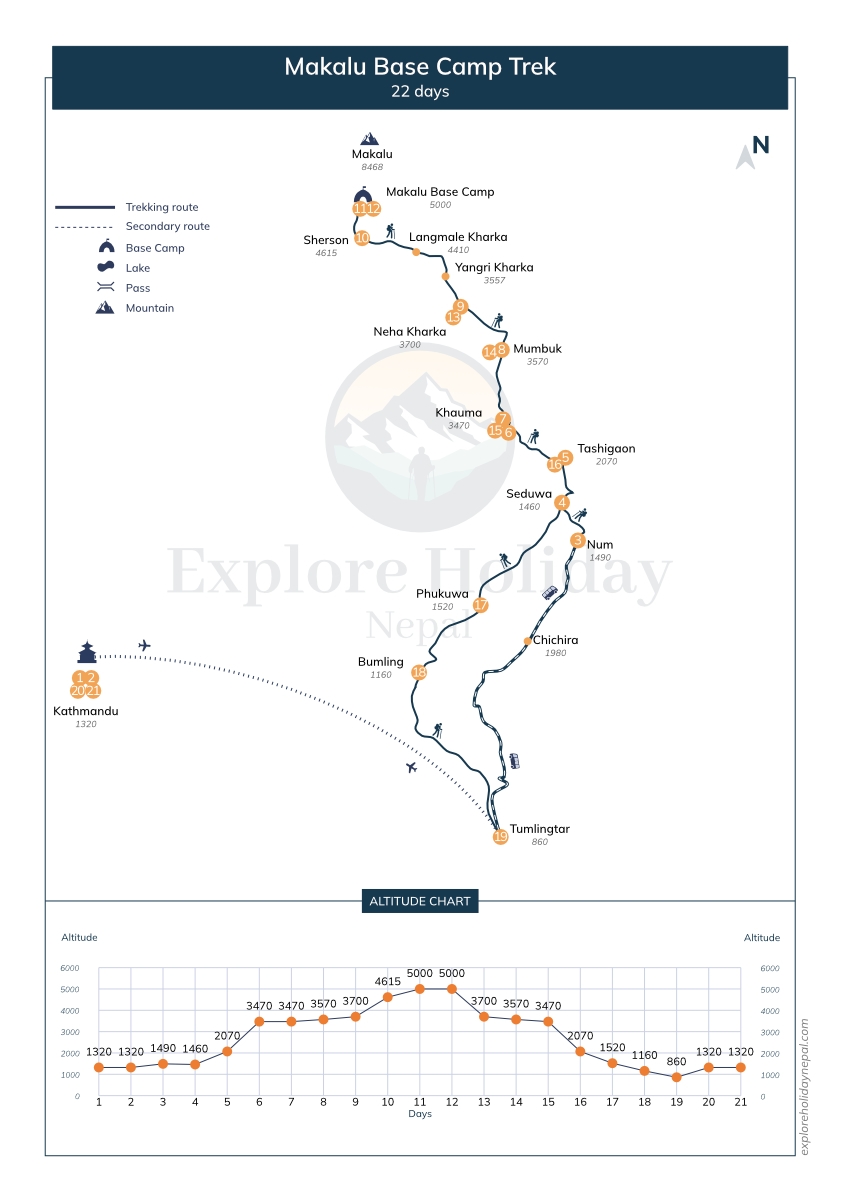
Makalu Base Camp Trek
| Trip code | |
| Package name | Makalu Base Camp Trek |
| Duration | 20 |
| Max. elevation | 4870 m |
| Level | Difficult |
| Transportation | Domestic flight as per Itinerary and all around transportation |
| Accomodation | Hotel in Kathmandu and Tea House / Lodge during the trek |
| Starts at | Kathmandu |
| Ends at | Kathmandu |
| Trip route | Kathmandu - Tumlingtar - Num - Sedua - Tashi Gaun - Kauma - Mumbuk - Neha Kharka - Sherson - Makalu Base Camp - Neha Kharka - Mumbuk - Kauma - Pakuwa - Bumling - Tumlingtar - Kathmandu |
| Cost | USD 2,330 per person |
Highlights
- Witness awe-inspiring views of Mount Makalu, the fifth-highest mountain in the world, along with neighboring peaks like Chamlang and Baruntse.
- Trek through the picturesque Barun Valley, surrounded by towering peaks, and cross the dramatic Arun River Gorge, providing breathtaking vistas.
- Experience diverse landscapes, from lush tropical forests at lower elevations to alpine meadows and glaciated terrain as you ascend toward Makalu Base Camp.
- Explore the Makalu Barun National Park, a pristine conservation area that is home to a rich variety of flora and fauna, including red pandas, Himalayan tahr, and diverse bird species.
- Challenge yourself with the ascent of Shipton La Pass, offering panoramic views of Makalu, Everest, and other surrounding peaks.
- Reach Makalu Base Camp and marvel at the close-up views of Makalu's massive south face, surrounded by towering icefalls and glaciers.
- Encounter the unique cultures of remote villages like Num, Seduwa, and Tashi Gaon, where you can interact with the friendly local communities and witness their traditional lifestyles.
Overview
Makalu Base Camp Trek: Where Fewer Footprints Lead to Greater Rewards
Look, I'm not going to pretend the Makalu Base Camp Trek is for everyone. It's remote, it's challenging, and you won't find the comfortable teahouse infrastructure you'd get on the Annapurna Circuit or Everest Base Camp. But that's exactly why it's special.
When I tell people I trekked to Makalu Base Camp, most don't even know where Makalu is. Fifth-highest mountain in the world at 8,485 meters, sitting in the far eastern corner of Nepal, and somehow still flying under the radar while Everest gets all the attention just a valley over.
What Makes Makalu Different
The Makalu region doesn't mess around with gentle introductions. From the moment you start trekking, you're either going steeply up or steeply down. There's no "warm-up" section. The trail drops into river valleys, climbs back out to ridges, and repeats this pattern until your legs question every decision you've ever made.
But here's what you get in return: solitude. Real solitude. On popular treks, you're never really alone. Here? You might go hours without seeing another trekker. The trails feel wild in a way that's increasingly rare in Nepal. When you do encounter other trekkers, there's an instant Bond—you nod at each other like members of a secret club who know something the crowds don't.
The trek takes you through the Makalu-Barun National Park, one of Nepal's most biodiverse protected areas. The elevation range is insane—you start around 400 meters in subtropical jungle and end up above 5,000 meters in a high-altitude glacial zone. That's basically going from tropical to arctic in two weeks of walking.
The Mountain Itself
Mount Makalu is shaped like a perfect pyramid with four sharp ridges. When you finally see it up close from base camp, it doesn't look real. It's too symmetrical, too massive, too perfectly shaped. The mountain has this presence that's different from other peaks—maybe because fewer people have stood where you're standing, staring up at it.
The Makalu massif includes several other significant peaks—Makalu II, Makalu III, Chamlang (7,319m), and Baruntse (7,129m). These aren't minor foothills; they're legitimate Himalayan giants that would be celebrities in their own right if they weren't overshadowed by their taller neighbor.
From various points along the trek, you get different perspectives of these peaks. Sometimes they're hidden by clouds or ridgelines, then suddenly you'll round a corner and there they are, filling the entire sky. It never stops being breathtaking.
The Trail: A Study in Contrasts
Subtropical Jungle to Alpine Desert
The lower sections of the trek wind through dense subtropical forests that feel more like jungle than mountain trail. It's hot, humid, and sometimes muddy. You'll be sweating through your shirt, swatting at insects, and wondering why you didn't just go to Ghorepani Poon Hill instead.
Then you climb higher and enter rhododendron forests. If you're trekking in spring, these forests explode with blooms—red, pink, white flowers covering massive old-growth trees. Even outside blooming season, these forests have this ancient, primeval quality. Moss hangs from branches, sunlight filters through the canopy, and everything feels untouched.
Higher still, the vegetation thins dramatically. You enter alpine meadows dotted with wildflowers (in season), then finally reach the barren, rocky landscape near base camp where almost nothing grows except the occasional hardy alpine plant clinging to life.
River Valleys and High Passes
The Arun Valley, which you'll traverse in the early sections, is one of the deepest valleys in the world. Standing on a ridge and looking down at the river thousands of feet below, then up at peaks thousands of feet above—it's vertigo-inducing even when you're standing still.
The trail crosses countless suspension bridges over rushing rivers. Some are sturdy and well-maintained, others sway alarmingly and have gaps between the planks where you can see straight down to the rapids below. You get used to them, but that first wobbly crossing gets your attention.
Then there's Shipton La pass, sitting at around 4,200 meters. Named after the legendary explorer Eric Shipton, this pass marks the transition from the Arun Valley to the Barun Valley. The climb up is brutal—steep, relentless, and thin on oxygen. But from the top, the views stretch across ranges of peaks in every direction.
The Barun Valley: A Hidden Sanctuary
The Barun Valley is genuinely special. This valley is protected within the national park and remains pristine because of its remoteness. The landscape here is dramatic—massive rock walls, hanging glaciers, waterfalls that appear out of nowhere, and a sense of being completely removed from the modern world.
The biodiversity in the Barun Valley is remarkable. The park is home to over 400 species of birds, including rare ones like the blood pheasant and impeyan pheasant. Mammals include the elusive snow leopard, red panda, Himalayan black bear, and musk deer. Seeing any of these requires serious luck—they're masters at avoiding humans—but knowing they're there adds to the wild feeling of the place.
I didn't see a snow leopard (few people ever do), but we found fresh paw prints in the snow one morning near our camp. Our guide got excited and pointed out how you could see where the leopard had been stalking along a ridgeline. Just knowing that a snow leopard had walked that exact spot hours before us felt significant.
Cultural Encounters
The lower villages are primarily inhabited by Rai people, an Original ethnic group with their own distinct language and traditions. As you climb higher, you'll encounter Sherpa communities who have adapted to life at extreme altitudes.
Unlike the lodges on more popular treks, accommodations in the Makalu region are basic. Really basic. Many villages have simple homestays where you're sleeping in a family's home, sharing meals around a fire, and getting a glimpse into daily life that feels far removed from the tourist trail.
In villages like Tashigaon and Khongma, you'll see traditional stone houses with slate roofs, prayer flags fluttering in the wind, and locals going about their daily routines—tending fields, herding yaks, working at subsistence farming that hasn't changed much in generations.
The cultural aspect here isn't performed for tourists because there aren't enough tourists to perform for. It's genuine. When villagers invite you for tea, they're not running a business—they're being hospitable. When you see a religious ceremony, you're not attending a show—you're witnessing something that would happen whether you were there or not.
Makalu Base Camp: The Destination
Base camp sits at around 5,000 meters in a rocky glacial Valley. When you finally arrive after nearly two weeks of trekking, the sense of accomplishment is intense. You're standing in one of the most remote corners of the Himalayas, surrounded by some of the highest peaks on Earth, and there might be only a handful of other people in the entire valley.
The camp itself isn't much—some flat spots for tents, a stone shelter if you're lucky, and absolutely nothing else. No lodge, no facilities, no cell service. Just rock, ice, sky, and mountains.
But the views. Makalu dominates the skyline, its pyramid shape rising directly above you. The surrounding peaks form this Arena of ice and rock. Glaciers spill down from the heights, grinding their way through the valley. The scale is difficult to process.
Most people spend a rest day at base camp, partly for acclimatization and partly because after working so hard to get there, you want to soak it in. Some climb to higher viewpoints for even better perspectives. Others just sit and stare, which is honestly all you need to do.
The Wildlife Factor
The Makalu-Barun National Park hosts some of Nepal's rarest and most Mysterious wildlife. The red panda lives in the rhododendron forests at middle elevations—you might see one if you're incredibly fortunate, move quietly, and trek early in the morning or late afternoon when they're most active.
Snow leopards roam the higher elevations, but they're called "ghosts of the mountain" for good reason. Your best chance of evidence is finding tracks or scat, which is still thrilling for wildlife Fans.
More commonly seen (though still requiring luck and patience) are Himalayan thar, musk deer, and various bird species. The impeyan pheasant(Himalayan Monal), Nepal's national bird, is sometimes spotted in the forests, and its call is distinctive once you learn to recognize it.
Even if you don't see rare animals, just trekking through habitat that supports such biodiversity adds another layer to the experience. You're not just walking through pretty scenery—you're moving through a functioning ecosystem that includes some of the world's most specialized alpine creatures.
The Challenge Factor
Let me be clear: this is a serious trek. It's longer and more demanding than Annapurna Base Camp or Langtang Valley. The daily elevation gains and losses are substantial. The terrain is rough. The altitude affects everyone differently, but you'll be spending extended time above 4,000 meters.
The trek typically takes 18-21 days round trip, depending on your route and acclimatization needs. That's three weeks of camping or very basic accommodation, simple food, and hard physical work every day. You need to be properly fit before attempting this.
Weather can change rapidly. Even in the best seasons (spring and autumn), you might encounter snow, rain, or clouds that obscure views for days. The remoteness means if something goes wrong, evacuation is complicated and expensive. This isn't a trek to take lightly.
But the difficulty is part of what keeps the crowds away. The Makalu Base Camp Trek self-selects for people who are serious about remote mountain trekking and willing to rough it for the experience.
Seasons and Timing
Spring (April to May) is considered the best season. The rhododendron forests are blooming, weather is generally stable, and temperatures are manageable. This is also when climbing expeditions attempt Makalu, so you might see base camp activity from mountaineers preparing for summit attempts.
Autumn (October to November) offers the clearest views and most stable weather. Post-monsoon air creates sharp visibility, and the temperatures are cool but not brutally cold. This is probably the most popular time (relatively speaking—it's still quiet compared to mainstream treks).
Winter (December to February) is possible for experienced trekkers, but it's seriously cold at higher elevations, and some passes may be snow-covered or closed. The lower villages are warmer, making this season feasible if you're prepared for winter conditions above 4,000 meters.
Monsoon (June to September) is not recommended. Heavy rainfall makes trails slippery and dangerous, leeches are abundant in the lower forests, and mountain views are typically obscured by clouds. The few people who trek during monsoon usually have specific reasons (research, filming, etc.).
Logistics and Planning
The Camping vs. Teahouse Situation
Unlike treks where you move from lodge to lodge, much of the Makalu trek requires camping. Some lower villages have basic homestays or lodges, but higher up, you're in tents. This means you'll need a support team—guides, porters, kitchen staff, and someone to manage camp.
Going with an organized group or hiring a trekking company is essentially mandatory unless you're an experienced mountaineer comfortable with self-supported camping at altitude. This isn't like Manaslu Circuit where teahouses are available even if sparse.
Permits and Regulations
You'll need several permits: the Makalu-Barun National Park permit, a restricted area permit (this is a controlled trekking region), and a TIMS card. These permits aren't cheap, and regulations require you to trek with a registered guide in this area—solo trekking isn't permitted.
The permit requirements exist partly for safety (this is remote territory where rescue is difficult) and partly for conservation (limiting numbers helps protect the ecosystem). While it adds to the cost and complexity, the regulations help maintain the pristine quality of the region.
Flights and Access
Most Makalu treks start with a flight from Kathmandu to Tumlingtar, a small airstrip in the hills of eastern Nepal. These are small planes, and flights can be delayed or cancelled due to weather—build flexibility into your schedule.
From Tumlingtar, you'll drive a few hours to the trailhead. The roads in this region are rough, and during monsoon, they can be impassable. This access difficulty is another factor that keeps visitor numbers low.
What to Pack
Standard high-altitude trekking gear applies, but since you're camping, you'll need:
Four-season tent (usually provided by trekking company) Cold-rated sleeping bag (minus 15-20°C at minimum) Insulated sleeping pad (the ground at high altitude is cold) Layers for extreme temperature variation (hot in valleys, freezing at altitude) Sturdy boots broken in completely (rough terrain demands good footwear) Trekking poles (essential for the steep descents and ascents) Water purification system (no lodges means filling from streams) Headlamp with extra batteries (nights in camp are long and dark) Sun protection (UV exposure is intense at altitude)
Since you're camping, you'll have porters carrying gear, but keep your personal daypack relatively light. You're still carrying it all day, every day.
Comparing Makalu to Other Remote Treks
If you're considering remote treks, here's how Makalu compares:
Manaslu Circuit - More teahouse infrastructure, slightly less remote feeling, but still wonderfully uncrowded and with spectacular mountain views.
Kanchenjunga Base Camp - Similar remoteness level to Makalu, equally pristine, but trekking to the world's third-highest mountain instead of the fifth. Also requires camping and full support.
Upper Dolpo - Even more remote than Makalu, with a unique Tibetan Buddhist culture and desert-like landscapes. Longer and more expensive.
Upper Mustang - Remote and restricted, but with village lodges available. Different landscape (high-altitude desert) and strong Tibetan cultural elements.
If Makalu feels too ambitious, consider the Langtang Valley Trek or Annapurna Base Camp—both offer spectacular mountain views with much better infrastructure and easier logistics.
Why Choose the Makalu Base Camp Trek
This trek isn't about collecting stamps in your trekking passport or bragging rights. It's about experiencing the Himalayas in a way that's becoming increasingly rare—genuinely remote, uncrowded, wild.
You'll work hard for it. The trek is physically demanding, logistically complex, and requires significant time and financial investment. But you'll walk through ecosystems that range from tropical to arctic, through valleys where wildlife outnumbers humans, to the base of one of Earth's most impressive mountains.
The lack of infrastructure means you're more self-reliant and need to carry or have carried everything you'll need. But it also means no lodge noise, no crowds at viewpoints, no feeling of being on a conveyor belt of tourists.
Final Thoughts
The Makalu Base Camp Trek is for trekkers who've done the classic routes and want something more challenging and remote. It's for people who prioritize wilderness experience over comfort, who find solitude appealing rather than lonely, and who want to see a part of the Himalayas that relatively few outsiders ever witness.
The physical demands are real—don't underestimate them. The remoteness means you need to be self-sufficient and properly prepared. But if you're ready for that, Makalu offers something increasingly precious in our connected, crowded world: genuine wilderness and the sense of discovery that comes with truly remote travel.
Standing at Makalu Base Camp, surrounded by peaks, with maybe a dozen other people in the entire valley, you'll understand why some trekkers become addicted to these wild places. The silence, the scale, the raw beauty of mountains that don't care whether you're there or not—it changes your perspective on what matters.
Just make sure you're properly prepared, physically fit, and mentally ready for the challenge. The mountains will be there, indifferent and magnificent, waiting for those willing to make the journey.
Explore More Remote Nepal Treks
If Makalu appeals to you, consider these other off-the-beaten-path adventures:
Remote & Challenging:
- Kanchenjunga Base Camp Trek - World's third-highest peak, equally remote
- Manaslu Circuit Trek - Less crowded alternative to Annapurna Circuit
- Upper Dolpo Trek - One of Nepal's most remote regions
- Upper Mustang Trek - Tibetan culture in high-altitude desert
More Accessible Options:
- Everest Base Camp Trek - Classic high-altitude trek with good infrastructure
- Annapurna Base Camp Trek - Shorter duration with excellent mountain views
- Langtang Valley Trek - Beautiful and less crowded than Everest/Annapurna
Contact us to start planning your Himalayan adventure.
Top Blogs About Trekking in the Makalu Region:
Uncover the best blogs about trekking in the Makalu region, featuring expert advice, detailed itineraries, personal experiences, and essential tips for adventurers looking to explore the Himalayas.
Altitude Sickness on Nepal Treks: Symptoms, Treatment, and When to Descend (Complete Guide)
Nepal Trekking Permits: Costs, Types, and How to Get Them
Nepal Trekking: What’s the Best Time to Go?
Budget Trekking in Nepal: Tips, Trails, and Tricks
Exploring Nepal’s Wildlife and Nature
Trekking Through Nepal: A Journey into the Himalayas
Top 10 Mountain Peaks in Nepal
Monastery Life in Nepal: Finding Peace in the Heart of the Himalayas
Trip Preparation
- Thermal underwear (top and bottom)
- Moisture-wicking t-shirts (long-sleeved)
- Moisture-wicking underwear
- Fleece jacket or pullover
- Insulated down or synthetic jacket
- Waterproof, windproof jacket (Gore-Tex or similar)
- Waterproof, windproof pants (Gore-Tex or similar)
- Warm beanie or hat
- Sun hat or cap
- Neck gaiter or scarf
- Trekking pants (convertible preferred)
- Waterproof trousers
- Lightweight gloves (inner)
- Insulated gloves or mittens (outer)
- Hiking boots (broken in and waterproof)
- Comfortable camp shoes (e.g., sneakers or sandals)
- Trekking backpack (30-40 liters) with waterproof cover
- Sleeping bag (rated for cold temperatures)
- Sleeping pad or mattress (insulated)
- Adjustable trekking poles
- Insulated water bottles or hydration bladder (2 liters capacity)
- Travel-sized toiletries
- Biodegradable soap
- Quick-dry towel
- Medications for altitude sickness, pain relief, and common ailments
- Sun protection cream, wet wipes, and hand sanitizer
- Camera and batteries
- Notebook and pen
- Earplugs (for sleeping in lodges)
- Portable solar charger
- Headlamp, power bank, and extra batteries
Trip Itinerary
Day 1 : Arrive Kathmandu and Transfer to Hotel.
Welcome to Nepal! Upon your arrival in Kathmandu, you will be greeted by our representative from Explore Holiday Treks and transferred to your hotel. Take some time to relax and acclimatize to the new environment. In the evening, you can explore the vibrant streets of Thamel, visit local shops, or enjoy traditional Nepali cuisine at a nearby restaurant. A pre-trek briefing will be arranged, where you can ask questions and finalize your trekking arrangements.
Day 2 : Kathmandu to Tumlingtar - Drive to Num
An early morning drive will take you to Tumlingtar, a beautiful town that serves as the gateway to the Makalu region. Enjoy the scenic views of lush hills and valleys as you travel. Upon reaching Tumlingtar, you will continue your journey by driving to Num, a small village perched on a ridge. The drive takes about six to seven hours, and once in Num, you’ll settle into a local guesthouse for the night.
Day 3 : Num (1,490m) - Sedua (1,460m - 5/6 hrs. hiking)
Today marks the beginning of your trek. After breakfast, set off from Num towards Sedua. The trail descends through terraced fields and forests, providing stunning views of the valleys below. As you hike, you’ll encounter local villages and the warm hospitality of the communities living along the route. After approximately five to six hours of hiking, you will arrive in Sedua, where you can enjoy a cozy lodge and the tranquility of the surroundings.
Day 4 : Sedua (1,460m) - Tashi Gaun (2,070m - 5 hrs. Hiking)
Leaving Sedua, the trail ascends gently towards Tashi Gaun. This village is known for its picturesque views and rich cultural heritage. The hike takes around five hours, passing through lush forests and local settlements. Along the way, take breaks to enjoy the views and capture photographs. Upon reaching Tashi Gaun, settle into your lodge and experience the local way of life.
Day 5 : Tashi Gaon (2,070m) - Kauma (3,470m - 6 hrs. Hiking)
Today’s trek is a significant ascent as you make your way to Kauma. The trail climbs steadily through beautiful landscapes filled with rhododendron and pine forests. The effort will reward you with magnificent views of the Makalu region. After about six hours of hiking, you will reach Kauma, a high-altitude settlement. Here, you can rest and acclimatize to the elevation.
Day 6 : Kauma (3,470m)
This day is set aside for acclimatization. Spend your time exploring the stunning surroundings of Kauma. You can take short hikes in the area to help your body adjust to the altitude. Engage with local villagers, learn about their traditions, or simply relax and enjoy the breathtaking views of the Himalayas.
Day 7 : Kauma (3,470m) - Mumbuk (3,570m - 5 hrs. Hiking)
After acclimatizing, you will continue your trek to Mumbuk. The trail offers captivating views and a pleasant hiking experience. It takes approximately five hours to reach Mumbuk, a small settlement nestled in a picturesque valley. Upon arrival, you can explore the area, relax at your lodge, and enjoy the peaceful ambiance.
Day 8 : Mumbuk (3,570m) - Neha Kharka - (3,700m - 6 hrs. Hiking)
Today’s trek leads you to Neha Kharka. The trail ascends gradually through dense forests and beautiful landscapes. You’ll experience the serenity of the high-altitude environment as you hike for about six hours. Arriving at Neha Kharka, you will find yourself surrounded by stunning views and the sounds of nature, making it an ideal spot to unwind.
Day 9 : Neha Kharka - (3,700 m) - Sherson (4,615 m - 7 hrs. Hiking)
Prepare for a challenging day as you trek to Sherson. The trail climbs steeply, offering breathtaking views of Makalu and other peaks. After approximately seven hours of hiking, you will reach Sherson, situated at a high altitude. This location serves as a perfect base for exploring Makalu Base Camp. Take in the stunning scenery and enjoy a restful evening.
Day 10 : Sherson (4,615 m) - Makalu Base Camp (5,000 m - 4/5 hrs. Hiking)
This is the day you’ve been waiting for—the trek to Makalu Base Camp. The trail leads you through rocky terrain and offers spectacular views of the surrounding mountains. After about four to five hours of hiking, you will arrive at Makalu Base Camp, situated at an elevation of 5,000 meters. Take time to explore the area and soak in the majestic beauty of the world’s fifth-highest mountain.
Day 11 : Explore Makalu Base Camp
Take a day to explore Makalu Base Camp, surrounded by towering peaks and glaciers. Capture the stunning scenery, and absorb the tranquility of this remote and pristine Himalayan location.
Makalu Base Camp, situated at an elevation of approximately 16,404 feet (5,000 meters), stands as a remote and breathtaking destination in the eastern Himalayas of Nepal. Offering panoramic views of Mount Makalu, the fifth-highest peak globally, the base camp provides trekkers with a stunning perspective of the surrounding peaks, including Everest and Lhotse. The landscape is characterized by diverse terrains, from lush rhododendron and alpine meadows to rugged rocky landscapes, creating a captivating backdrop for the trek. Along the journey, trekkers may encounter the cultural richness of the region, interacting with local communities such as the Sherpas and ethnic groups like the Rai and Limbu. The trek to Makalu Base Camp seamlessly combines awe-inspiring mountain views, varied landscapes, and cultural experiences, making it a unique and challenging adventure in the eastern Himalayas.
Day 12 : Makalu Base Camp to Neha Kharka (3,700 m)
Begin your descent back to Neha Kharka. The return journey provides a different perspective of the stunning landscapes you traversed earlier. After about six hours of hiking, you will arrive at Neha Kharka. Here, you can relax and reflect on the incredible experiences of the past days.
Day 13 : Neha Kharka - (3,700 m) – Mumbuk (3,570 m)
Trek back to Mumbuk today, retracing your steps through the lush forests and scenic trails. The hike takes approximately five hours, allowing you to appreciate the beauty of the region once more. Upon arrival in Mumbuk, enjoy the comfortable lodgings and the welcoming atmosphere of the local community.
Day 14 : Mumbuk (3,570 m) - Kauma (3,470 m)
Continue your descent to Kauma, which takes about an hour and a half. The trail winds through beautiful landscapes, making it a pleasant and relaxing hike. Once in Kauma, you can spend the day enjoying the views and perhaps chatting with locals about their daily lives.
Day 15 : Kauma (3,470 m) - Tashi Gaon (2,070 m)
Today, you will hike back down to Tashi Gaon. The descent is easier on the legs, and you’ll be treated to stunning views along the way. The trail takes about six hours, leading you back through forests and small villages. Upon arriving in Tashi Gaon, you can unwind and enjoy the familiar surroundings.
Day 16 : Trek to Pakuwa (1,520 m)
Leaving Tashi Gaon, you’ll trek to Pakuwa. The trail offers beautiful landscapes and a glimpse into rural Nepali life. This journey takes around six to seven hours, leading you through terraced fields and lush greenery. Once in Pakuwa, relax and enjoy the serene atmosphere.
Day 17 : Pukuwa (1,520m) to Bumling (1,160m)
Today, continue your trek to Bumling, a small village that serves as a resting point. The trail is gentle and offers scenic views of the surrounding hills. After a trek of about five hours, you will arrive in Bumling, where you can interact with locals and enjoy the peaceful environment.
Day 18 : Bumling to Tumlingtar (860 m)
The final leg of your trek will take you back to Tumlingtar. The trail descends gently, and after about six hours of hiking, you will arrive at this lively town. Enjoy your last evening in the hills, perhaps reflecting on the adventure with your trekking companions.
Day 19 : Tumlingtar to Kathmandu
After breakfast, you will drive back to Kathmandu. The journey will take approximately eight hours, offering scenic views along the way. Upon your return, check into your hotel and take the evening to relax, shop for souvenirs, or revisit your favorite spots in the city.
Day 20 : Final Departure
On your final day, enjoy a leisurely breakfast at your hotel. Depending on your flight schedule, you may have time for some last-minute shopping or sightseeing. Our representative will assist you with your transfer to the airport for your departure. Safe travels and thank you for joining us on this incredible journey!
- 1 - 1 pax US$ 2,500
- 2 - 5 pax US$ 2,390
- 6 - 9 pax US$ 2,370
- 10 - 15 pax US$ 2,350
- 16 - 20 pax US$ 2,330
Inclusions
What is included?
- All arrival and departure transportation from the airport to hotel and vice versa.
- Accommodation in a hotel in Kathmandu with breakfast included.
- A guided tour of Kathmandu.
- Domestic flights from Kathmandu to Tumlingtar and back.
- All necessary permits for trekking, including Makalu Barun National Park Entry Permit.
- Full board during the trek, which means meals (breakfast, lunch, and dinner).
- The trek includes a guide and porters, who will receive daily wages, meals, accommodation, transportation allowance, and medical insurance (only for field staff/porters).
- A group dinner upon arrival or departure, with a briefing about the trek.
- A comprehensive medical kit carried by our guide during the entire trek.
- Private vehicles for sightseeing tours based on the group size, accompanied by a city guide.
What isn't included?
- Nepal visa and medical/travel insurance are not included.
- Meals in Kathmandu and personal expenses like laundry are not covered.
- If you prefer a single room in Kathmandu or during treks (where available), there's an additional cost.
- Emergency evacuation, whether by any means of transportation or helicopter service, is an extra expense.
- You need to bring your personal trek gear, including sleeping bags, duvet/down jackets, and kit/duffel bags.
- Additional snacks, refreshments, and drinking water are at your own cost.
- If you have to return early from the trek due to personal reasons or sickness, you'll need to cover the extra expenses yourself (can be claimed from your insurance).
- Bring a personal medical kit based on your doctor's advice.
Complimentary
Booking Terms and Conditions
Booking, Cancellation, and Refund Policy
Transportation
Trip and the Weather
Makalu Base Camp Trek Starting and Ending Points
Major Trips for Makalu Base Camp Trek
Best Time for Makalu Base Camp Trek
Makalu Trekking Difficulty
Food and Accommodation
Communication and Networking
Explore Holiday Treks Team for Makalu Trek
Important Note
Why with Explore Holiday Treks