Langtang Valley Trek
| Trip code | |
| Package name | Langtang Valley Trek |
| Duration | 10 |
| Max. elevation | 3749 m |
| Level | Moderate |
| Transportation | All ground transportation as per itinerary |
| Accomodation | Hotel in Kathmandu and Tea house / Lodge during the trek |
| Starts at | kathmandu |
| Ends at | kathmandu |
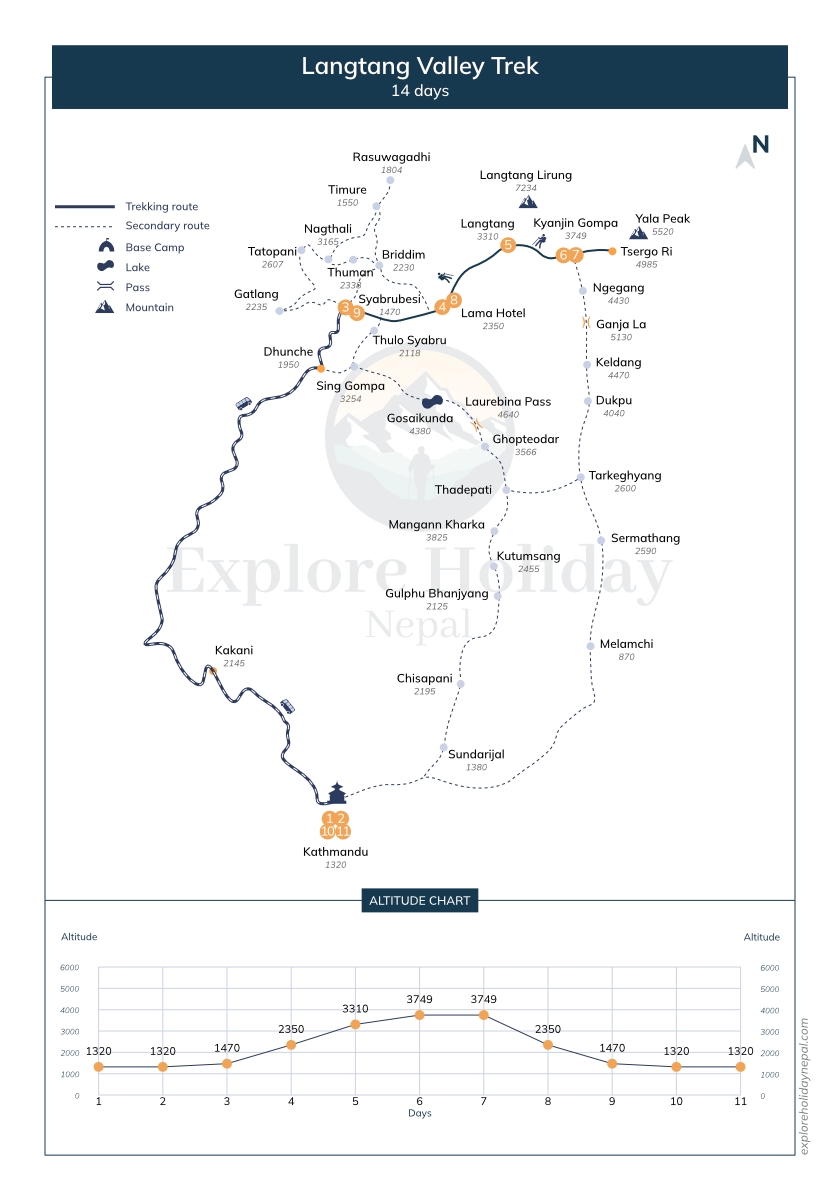
| Trip route | Kathmandu - Syabrubesi - Lama Hotel - Langtang Village - Kyanjin Gompa - Lama Hotel - Syabrubesi - Kathmandu |
| Cost | USD 735 per person |
Highlights
- Breathtaking views of the Langtang Lirung mountain range and other snow-capped peaks throughout the trek.
- Encounter the unique Tamang culture and traditions, with opportunities to visit local villages and interact with friendly locals.
- Reach Kyanjin Gompa, a scenic village with a Buddhist monastery, providing stunning panoramic views of the surrounding mountains.
- Trek through Langtang National Park, home to diverse flora and fauna, including the red panda, Himalayan tahr, and various bird species.
- Possibility to include a side trek to the sacred Gosaikunda Lake, a high-altitude alpine lake with religious significance.
- Enjoy trekking through beautiful rhododendron and bamboo forests, especially vibrant during the spring season.
- Experience the local Tamang cuisine and hospitality by staying in tea houses along the trail.
- Explore traditional villages like Langtang Village, where you can observe the unique architecture and daily life of the locals.
- Traverse through serene alpine meadows, offering a peaceful and picturesque environment.
- Optional side trek to Gosainkunda Lake, a sacred high-altitude lake surrounded by majestic mountain views.
- Combine the trek with the Tamang Heritage Trail for a more immersive cultural experience.
- Witness varied landscapes, from terraced fields and dense forests to high mountainous terrain.
- Enjoy panoramic views of the Helambu Valley as you descend from Kyanjin Gompa.
- Capture stunning sunrise views over the Himalayan peaks from strategic vantage points.
Overview
Langtang Valley Trek: Nepal's Hidden Himalayan Gem
I'll be straight with you—when I first planned my Nepal trip, Langtang wasn't even on my radar. Everyone talks about Everest Base Camp or the Annapurna Circuit. But after spending over a week in the Langtang Valley, I realized I'd accidentally stumbled onto something special that doesn't get nearly enough attention.
Langtang is originated from two words, ‘Lang’ means Yak and ‘Tang’ means to follow. The highest peak Langtang Lirung – 7,246m in the area dominates the narrow Langtang Valley which is situated on the lap of Langtang Himal, north of Kathmandu. The Langtang trek to the base of Langtang Himal offers the shortest approach to snow-white mountains from Kathmandu.
Why Langtang Deserves Your Attention
The Langtang Valley sits just north of Kathmandu, wedged between the main Himalayan range and a series of peaks that mark the Tibetan border. What makes it different from Nepal's more famous treks isn't just the scenery—though trust me, the views rival anything you'll see on the Manaslu Circuit or Annapurna Base Camp treks. It's the feeling of the place.
You're walking through a valley that was nearly erased in 2015 when a massive earthquake triggered avalanches that buried entire villages. The communities here rebuilt everything from scratch. When you trek through Langtang, you're not just sightseeing—you're supporting people who refused to let disaster define them.
Plus, it's genuinely less crowded. On other major treks, you're part of a parade. Here? You'll meet other trekkers, sure, but the trail never feels packed.
Getting There: The Journey Begins in Kathmandu
Your adventure starts with a drive from Kathmandu to Syabrubesi, the main starting point for the trek. Fair warning—this isn't a smooth highway cruise. It's about seven to eight hours of winding mountain roads that'll test your stomach. The roads have improved over the years, but it's still Nepal, so expect the occasional pothole that could swallow a small car.
That said, the drive itself offers a glimpse into rural Nepal that you won't get anywhere else. You'll pass through terraced hillsides where farmers work the same land their ancestors did centuries ago. Small villages cling to mountainsides. Rivers rush through valleys far below the road. It's chaotic and beautiful and slightly terrifying all at once.
Most people take a local bus or arrange private transport through their hotel. Both work fine—the private jeep is faster and more comfortable, the local bus is cheaper and more, let's say, authentic.
The Trail: What You're Actually Walking Through
The Langtang trail follows the Langtang Khola river, gradually climbing from around 1,500 meters at Syabrubesi up to nearly 4,000 meters at Kyanjin Gompa. The path winds through some of the most diverse terrain you'll encounter on any Himalayan trek.
The Forest Section
The first stretch takes you through dense rhododendron and oak forests. If you're trekking in spring (March to May), these forests explode with color—massive rhododendron trees bloom in shades of red, pink, and white. Even outside blooming season, there's something peaceful about walking through these ancient woods, with sunlight filtering through the canopy and the constant soundtrack of the river below.
You'll cross suspension bridges that sway gently (or not so gently) over rushing water. Some people love these crossings, others white-knuckle their way across. Either reaction is valid.
The forests are also home to wildlife, though you'll need patience and luck to spot much beyond langur monkeys and various bird species. The Langtang region is one of the few places in Nepal where red pandas still exist in the wild, but actually seeing one is rare. I didn't, though I kept my eyes peeled the entire time.
Opening into the Valley
As you gain altitude, the landscape shifts dramatically. The thick forests thin out, giving way to alpine meadows and juniper shrubs. This is where the views start getting serious. The valley walls rise steeply on both sides, with peaks that seem impossibly tall and close.
You'll pass through several Tamang villages along the way. These settlements have existed for generations, and the people here have adapted to mountain life in ways that seem almost superhuman to someone huffing and puffing from sea level.
Langtang Village: The Heart of the Valley
Langtang Village sits at about 3,430 meters and serves as the main hub for trekkers. This village has a heavy history—it was completely destroyed in the 2015 earthquake, buried under ice and rock. Over 300 people died, including trekkers and climbers.
The new village was built on higher ground, with modern construction designed to withstand future earthquakes. Walking through here, you'll see memorials and prayer flags marking where the old village once stood. It's sobering, but also inspiring to see how the community came back.
The lodge owners and locals here have stories that'll stick with you. Many lost family members but chose to return and rebuild. When I asked one lodge owner why she came back, she just shrugged and said, "This is home." That kind of resilience changes how you see the mountains around you.
Kyanjin Gompa: The Main Destination
Most trekkers make Kyanjin Gompa their primary destination. At 3,870 meters, this small settlement feels like the edge of the world. There's an ancient Buddhist monastery here—Kyanjin Gompa—which gives the place its name. The monastery has prayer wheels, butter lamps, and that distinctive smell of incense and yak butter that you'll either love or tolerate.
But the real draw is the setting. Kyanjin Gompa sits in a wide basin surrounded by snow-covered peaks. Langtang Lirung (7,227 meters) dominates the northern skyline—this massive pyramid of ice and rock that doesn't quite look real, especially at sunrise when it turns pink and gold.
There's also a cheese factory here, which sounds random until you try the cheese. It's made from yak milk and tastes nothing like what you're used to, but after several days of dal bhat, it's a welcome change.
The village itself is tiny—maybe a dozen buildings total. There's not much to "do" here in the conventional sense. You eat, you rest, you stare at mountains, you drink tea. That's kind of the point.
Side Treks and Viewpoints
If you're acclimatized and feeling ambitious, Kyanjin Gompa serves as a base for several side trips.
Tserko Ri
The most popular option is climbing Tserko Ri, a viewpoint at 4,984 meters that offers 360-degree panoramas of the Langtang range. I won't sugarcoat it—this hike is brutal. You're gaining over 1,000 meters of elevation, and the thin air makes every step feel like you're wearing ankle weights.
Most people start before dawn to catch sunrise from the summit. The early start means freezing temperatures and hiking by headlamp, but watching the first light hit the peaks from up there? Worth every miserable step. The entire Langtang range spreads out around you, and on clear days, you can see all the way to the Tibetan plateau.
Langshisa Kharka
If you have extra time and want to venture deeper into the valley, Langshisa Kharka offers even closer views of the glaciers that give Langtang its nickname as the "Valley of Glaciers." It's a longer day hike from Kyanjin Gompa, but the landscape becomes even more dramatic and otherworldly.
Kyanjin Ri
For a shorter option with excellent views, Kyanjin Ri (4,773 meters) can be climbed in a few hours and offers a great vantage point for photography, especially during golden hour.
The People and Culture
The Langtang region is primarily inhabited by Tamang people, an ethnic group with Tibetan origins. Their culture, language, and Buddhist traditions are distinct from other parts of Nepal. You'll see this in the architecture—stone houses with intricately carved wooden windows, prayer flags strung between buildings, and mani walls (stone walls carved with Buddhist mantras) along the trail.
The hospitality in these mountain communities is genuine. Staying in teahouses (basic lodges) means you're often sharing meals and stories with your hosts around a wood-burning stove. These aren't hotels—they're family homes that happen to accommodate trekkers. You'll learn about their lives, their challenges, and often share more than a few laughs despite language barriers.
Most guides and lodge owners speak decent English, picked up through years of working with trekkers. But even when communication is limited, there's something about sharing tea and a fire that transcends language.
When to Go: Seasons Matter
The Langtang Valley Trek is doable year-round, but your experience will vary dramatically depending on when you go.
Spring (March to May) is arguably the best time. The rhododendron forests are in full bloom, creating tunnels of color. The weather is generally stable with clear mornings and some afternoon clouds. Temperatures are comfortable for trekking, though nights at higher elevations get cold.
Autumn (September to November) offers the clearest mountain views and most reliable weather. Post-monsoon air creates incredibly sharp visibility. This is peak trekking season, so you'll encounter more people, but the trails never feel truly crowded compared to Everest or Annapurna routes.
Winter (December to February) brings fewer trekkers and pristine snow-covered landscapes. The downside? It's genuinely cold, especially at night at higher elevations. Some passes may be closed due to snow, and a few lodges shut down for the season. But if you're prepared for the cold and want solitude, winter has its appeal.
Monsoon (June to August) is generally not recommended. Heavy rainfall makes trails muddy and slippery, leeches become an issue in the forests, and mountain views are often obscured by clouds. However, the valley is beautifully green during this time, and you'll have the trails almost entirely to yourself.
Altitude: Take It Seriously
Even though Langtang doesn't reach the extreme elevations of some other Himalayan treks, altitude is still something you need to respect. You'll be spending several days above 3,000 meters and potentially reaching nearly 5,000 meters if you climb Tserko Ri.
Altitude sickness doesn't discriminate—fitness level doesn't matter. Some people cruise to 4,000 meters without issues, others struggle at 3,000 meters. The key is ascending slowly, staying hydrated, and listening to your body.
Common symptoms like headaches and mild nausea are normal as you acclimatize. But if you experience severe symptoms—confusion, difficulty breathing at rest, or inability to walk straight—you need to descend immediately. I'm not trying to scare you, just being real about the risks.
Most people find that taking rest days to acclimatize, drinking lots of water, and avoiding alcohol helps significantly. Some trekkers also use medication like Diamox to aid acclimatization, though that's something to discuss with your doctor before the trek.
Do You Need a Guide?
Technically, no—the Langtang trail is well-marked, and many people trek independently. But there are real advantages to hiring a guide.
First, local guides know the trail intimately. They know which lodges have the best food, where to stop for tea, and how to pace your days for proper acclimatization. They also understand weather patterns and can adjust plans if conditions turn bad.
Second, guides provide cultural context you'd miss otherwise. They'll explain the significance of monasteries, translate conversations with locals, and share stories about the region that turn the trek from a physical challenge into a genuine cultural experience.
Third, having someone who recognizes altitude sickness symptoms can be literally lifesaving. When I struggled on Tserko Ri, my guide knew exactly when to push and when to let me rest.
Finally, employing local guides directly benefits the communities you're trekking through. Tourism is vital to these mountain villages, and hiring guides and porters puts money directly into local pockets.
What to Pack: The Essentials
The Langtang Valley requires proper gear, but you don't need to buy out a specialty outdoor store.
Layers are your best friend. Mountain weather changes fast. You might start the day in a t-shirt and finish in every jacket you brought. A good system includes a moisture-wicking base layer, an insulating mid-layer (fleece or down), and a waterproof outer shell.
Footwear matters. You'll be walking for hours on rocky, sometimes muddy trails. Proper hiking boots with ankle support are worth the investment. Break them in before the trek—blisters at altitude are miserable.
Sun protection is non-negotiable. UV rays are much stronger at high altitude. Sunglasses, sunscreen, and a hat aren't optional luxuries—they're necessities. I learned this the hard way with a sunburn on my neck that hurt for days.
A good sleeping bag rated for cold temperatures is essential if you're trekking in shoulder seasons or winter. Even in peak season, nights at Kyanjin Gompa get chilly.
Water purification—either tablets, drops, or a filter system. You'll need to refill from streams and taps along the way.
Don't forget a headlamp, basic first aid supplies, and any personal medications. Phone charging is available at most lodges (usually for a small fee), but bring a power bank as backup.
The Food Situation
You'll primarily eat at teahouse lodges along the trail. The menu is surprisingly extensive—dal bhat (rice and lentil curry), fried rice, noodle soups, momos (dumplings), pasta, even the occasional pizza.
Dal bhat becomes your staple. It's nutritious, filling, and usually comes with free refills. There's a reason trekkers say "dal bhat power, 24 hour!" It genuinely fuels you for these long days of hiking.
The food gets progressively simpler as you gain altitude—ingredients need to be carried up by porters or yaks, so variety decreases. But honestly, after burning thousands of calories hiking, everything tastes better than it should.
Coffee is almost always instant Nescafe. Tea, however, is excellent—black tea with milk and sugar, ginger tea, lemon tea. If you're picky about coffee, make peace with that now or bring instant packets you actually like.
Internet and Connectivity
Cell service and WiFi exist but are spotty. Lower villages usually have decent connectivity. Higher up, it becomes unreliable and expensive. Many lodges charge for WiFi access, and even then, it might only work for a few hours per day.
Honestly? The digital disconnect is part of the appeal. You're in the Himalayas—embrace it. Download any maps or information you need before the trek and enjoy being unreachable for a week.
Permits You'll Need
You'll need two permits for the Langtang trek: a TIMS (Trekkers' Information Management System) card and a Langtang National Park entry permit. These can be obtained in Kathmandu or at checkpoints along the way. Your guide or trekking company typically handles this, but if you're going independently, you'll need to sort them yourself.
The permits aren't just bureaucracy—they help track trekkers for safety and the fees support conservation efforts and local communities.
Why Choose Langtang?
Here's the honest truth: Everest Base Camp is iconic, and Annapurna Circuit is stunning. But both have become extremely popular, sometimes overwhelmingly so.
Langtang offers comparable mountain scenery, rich cultural experiences, and challenging trekking without the crowds. You're still in the Himalayas, still surrounded by 7,000-meter peaks, still pushing your limits.
But you're also supporting communities that genuinely need tourism dollars to continue rebuilding. You're walking through forests and valleys that feel wilder and less trampled. You're having conversations with locals rather than just nodding at the endless stream of other trekkers.
The trek isn't easy—the altitude is real, the days are long, and you'll be sore. But standing in Kyanjin Gompa at sunrise, watching Langtang Lirung turn gold, or sitting around a fire sharing stories with your guide and lodge owners—these moments remind you why people trek in the first place.
It's not about conquering peaks or ticking boxes. It's about the combination of physical challenge, natural beauty, and human connection that only happens when you slow down enough to actually experience a place.
Final Thoughts
The Langtang Valley Trek won't give you bragging rights at parties the way Everest Base Camp might. It's not the most famous or the most Instagrammed route in Nepal.
But if you want a genuine Himalayan experience—one that challenges you physically, connects you with resilient communities, and offers stunning mountain landscapes without the circus atmosphere—Langtang delivers.
Just remember to take your time with altitude, respect the local culture, and maybe pack some Dramamine for that bus ride. Trust me on that last one.
📞 Ready to start your cultural Langtang Valley trekking trials ...
📱 WhatsApp/ Telephone +9779849816310 (Trekking Department)
📧 Email: [email protected]
Experience to local culture, mountain serenity, and a true Nepalese Hospitality in Nepal.
www.exploreholidaynepal.com
#langtangtrekking #exploreholidaynepal #NepalTrekking #langtang #sybrubesi
Top Blogs About Trekking in the Langtang Region:
Uncover the best blogs about trekking in the Langtang region, featuring expert advice, detailed itineraries, personal experiences, and essential tips for adventurers looking to explore the Himalayas.
Altitude Sickness on Nepal Treks: Symptoms, Treatment, and When to Descend (Complete Guide)
Nepal Trekking Permits: Costs, Types, and How to Get Them
Nepal Trekking: What’s the Best Time to Go?
Budget Trekking in Nepal: Tips, Trails, and Tricks
Exploring Nepal’s Wildlife and Nature
Trekking Through Nepal: A Journey into the Himalayas
Top 10 Mountain Peaks in Nepal
Monastery Life in Nepal: Finding Peace in the Heart of the Himalayas
Trip Preparation
- Thermal underwear (top and bottom)
- Moisture-wicking t-shirts (long-sleeved)
- Moisture-wicking underwear
- Fleece jacket or pullover
- Insulated down or synthetic jacket
- Waterproof, windproof jacket (Gore-Tex or similar)
- Waterproof, windproof pants (Gore-Tex or similar)
- Warm beanie or hat
- Sun hat or cap
- Neck gaiter or scarf
- Trekking pants (convertible preferred)
- Waterproof trousers
- Lightweight gloves (inner)
- Insulated gloves or mittens (outer)
- Hiking boots (broken in and waterproof)
- Comfortable camp shoes (e.g., sneakers or sandals)
- Trekking backpack (30-40 liters) with waterproof cover
- Sleeping bag (rated for cold temperatures)
- Sleeping pad or mattress (insulated)
- Adjustable trekking poles
- Insulated water bottles or hydration bladder (2 liters capacity)
- Travel-sized toiletries
- Biodegradable soap
- Quick-dry towel
- Medications for altitude sickness, pain relief, and common ailments
- Sun protection cream, wet wipes, and hand sanitizer
- Camera and batteries
- Notebook and pen
- Earplugs (for sleeping in lodges)
- Portable solar charger
- Headlamp, power bank, and extra batteries
Trip Itinerary
Day 1 : Arrival in Kathmandu 1,320 m and transfer to hotel
Upon arriving in Kathmandu at an elevation of 1,320 meters, your adventure begins. The transfer from the airport to your hotel is more than just a change of location—it marks the start of your journey into the vibrant culture, bustling streets, and rich energy of Nepal. Settle in, relax, and soak in the anticipation of the trekking adventure ahead, preparing yourself for the unforgettable experiences that await.
Day 2 : Drive to Syabrubesi 1,470 m via Dhunche town 1,950 - 06 hrs
Embark on a scenic drive to Syabrubesi, passing through the charming town of Dhunche. This journey is more than just transportation—it’s a visual odyssey through changing landscapes, with lush valleys, terraced fields, and rolling hills unfolding as you gradually ascend to 1,470 meters. Enjoy the serene mountain views and glimpses of rural Nepali life along the way, setting the tone for the trekking adventure ahead.
Day 3 : Trek to Lama Hotel 2,350 m - 06 hrs
The trek to Lama Hotel is more than just a walk—it’s a journey deeper into the heart of the Langtang Valley. Over approximately six hours, you will pass through lush forests, cross alongside murmuring rivers, and take in the serene natural beauty of the region. The trail gradually ascends to an altitude of 2,350 meters, offering breathtaking views and a peaceful trekking experience as you immerse yourself in the valley’s charm.
Day 4 : Trek to Langtang village 3,310 m - 05 hrs
Trekking to Langtang Village is an exciting journey into higher altitudes, taking approximately five hours. The trail gradually ascends, revealing not just a destination but a vibrant community nestled at 3,310 meters, surrounded by majestic Himalayan peaks.
Langtang Village, situated at 3,310 meters, is a charming and picturesque settlement in the heart of the Langtang Valley. The village is surrounded by towering mountains, lush forests, alpine meadows, and cascading waterfalls, creating a breathtaking backdrop for trekkers. Beyond its natural beauty, the village offers cultural encounters with the local Tamang community, allowing visitors to explore traditional houses, monasteries, and experience the region’s rich cultural heritage. The trek to Langtang Village combines stunning mountain scenery, diverse landscapes, and immersive cultural experiences, making it a truly memorable adventure in the Langtang Valley.
Day 5 : Trek to Kyanjin Gompa 3,749 m - 04 hrs
Ascending to Kyanjin Gompa is not just a climb it’s a journey into spiritual and serene Himalayan landscapes. Over approximately four hours, the trail gradually ascends to 3,749 meters, where the crisp mountain air and towering peaks create a sense of awe and tranquility.
At Kyanjin Gompa, you can explore the historic monastery, interact with local Tamang residents, and enjoy panoramic views of the surrounding Langtang Himal. The area is also known for its glacial moraines and yak pastures, offering a blend of cultural and natural experiences. This trek provides a rewarding combination of adventure, spirituality, and breathtaking Himalayan scenery, making it a highlight of the Langtang Valley journey.
Day 6 : Rest-Day for acclimatization and hike to view points
A rest day at Kyanjin Gompa isn’t just a pause—it’s a strategic break for acclimatization. Use this time to explore the surrounding area, visit nearby viewpoints, and allow your body to adjust to the higher altitude. It’s also a chance to soak in the serene mountain atmosphere, connect with the local community, and recharge both body and soul. This day ensures you are well-prepared for the upcoming trek back, making your journey safer and more enjoyable.
Day 7 : Trek to Lama Hotel - 06 hrs
Descending back to Lama Hotel is more than just retracing your steps—it’s a reflective journey through familiar landscapes, offering new perspectives and deeper appreciation of the Langtang Valley. The trek takes approximately six hours, passing through lush forests, riversides, and charming settlements. Along the way, you can pause to admire the scenery, capture memorable photos, and savor the peaceful mountain environment before arriving at Lama Hotel to rest and enjoy a warm meal.
Day 8 : Trek to Syabrubesi - 05 hrs
Retracing your steps to Syabrubesi is more than just a descent—it’s a farewell to the enchanting Langtang Valley. Over approximately five hours, the trail gently winds downward, offering one last chance to admire the majestic mountains, forests, and rivers. Each step becomes a reflection on the journey, as you soak in the beauty and tranquility of the valley before arriving in Syabrubesi to rest and prepare for the return to Kathmandu.
Day 9 : Drive to Kathmandu and transfer to your hotels - 06 hrs
The drive back to Kathmandu is more than just a return—it’s a reflective journey, transitioning from the serene beauty of the Langtang Valley to the vibrant energy of the capital city. The scenic drive takes approximately six hours, allowing you to relive the highlights of your trek, enjoy the changing landscapes, and soak in the memories of this unforgettable Himalayan adventure as your trekking odyssey comes to a close.
Day 10 : Departure
Depending on your flight schedule, you may have some free time in Kathmandu to explore, shop, or simply relax before your journey home. When it’s time, you will be transferred to the airport, marking the conclusion of your Langtang Valley Trek. Carry with you the unforgettable memories of the Himalayas, the serene valleys, and the warm hospitality you experienced throughout this incredible adventure.
- 1 - 1 pax US$ 900
- 2 - 5 pax US$ 780
- 10 - 15 pax US$ 750
- 16 - 20 pax US$ 735
Inclusions
What is included?
- All arrival and departure transportation from the airport to hotel and vice versa.
- Accommodation in a hotel in Kathmandu with breakfast included.
- A guided tour of Kathmandu.
- All necessary permits for trekking
- Full board during the trek, which means meals (breakfast, lunch, and dinner).
- The trek includes a guide who will receive daily wages, meals, accommodation, transportation allowance, and medical insurance (only for field staff/porters).
- A group dinner upon arrival or departure, with a briefing about the trek.
- A comprehensive medical kit carried by our guide during the entire trek.
- Private vehicles for sightseeing tours based on the group size, accompanied by a city guide.
- All government tax and service charge.
What isn't included?
- Nepal visa and medical/travel insurance are not included.
- Meals in Kathmandu and personal expenses like laundry are not covered.
- If you prefer a single room in Kathmandu or during treks (where available), there's an additional cost.
- Emergency evacuation, whether by any means of transportation or helicopter service, is an extra expense.
- You need to bring your personal trek gear, including sleeping bags, duvet/down jackets, and kit/duffel bags.
- Additional snacks, refreshments, and drinking water are at your own cost.
- If you have to return early from the trek due to personal reasons or sickness, you'll need to cover the extra expenses yourself (can be claimed from your insurance).
- Bring a personal medical kit based on your doctor's advice.
- TIPS and donations
Complimentary
Booking Terms and Conditions
Booking, Cancellation, and Refund Policy
Transportation
Trip and the Weather
Langtang Valley Trek Starting and Ending Points
Major Trips for Langtang Valley Trek
Best Time for Langtang Valley Trek
Langtang Valley Trekking Difficulty
Food and Accommodation
Communication and Networking
Explore Holiday Treks Team for Langtang Valley Trek
Important Note
Why with Explore Holiday Treks