Tamang Heritage Trek
| Trip code | |
| Package name | Tamang Heritage Trek |
| Duration | 10 |
| Max. elevation | 3165 m |
| Level | Moderate |
| Transportation | All ground transportation as per itinerary |
| Accomodation | Hotel in Kathmandu and Lodge / Tea House during the trek |
| Starts at | kathmandu |
| Ends at | kathmandu |
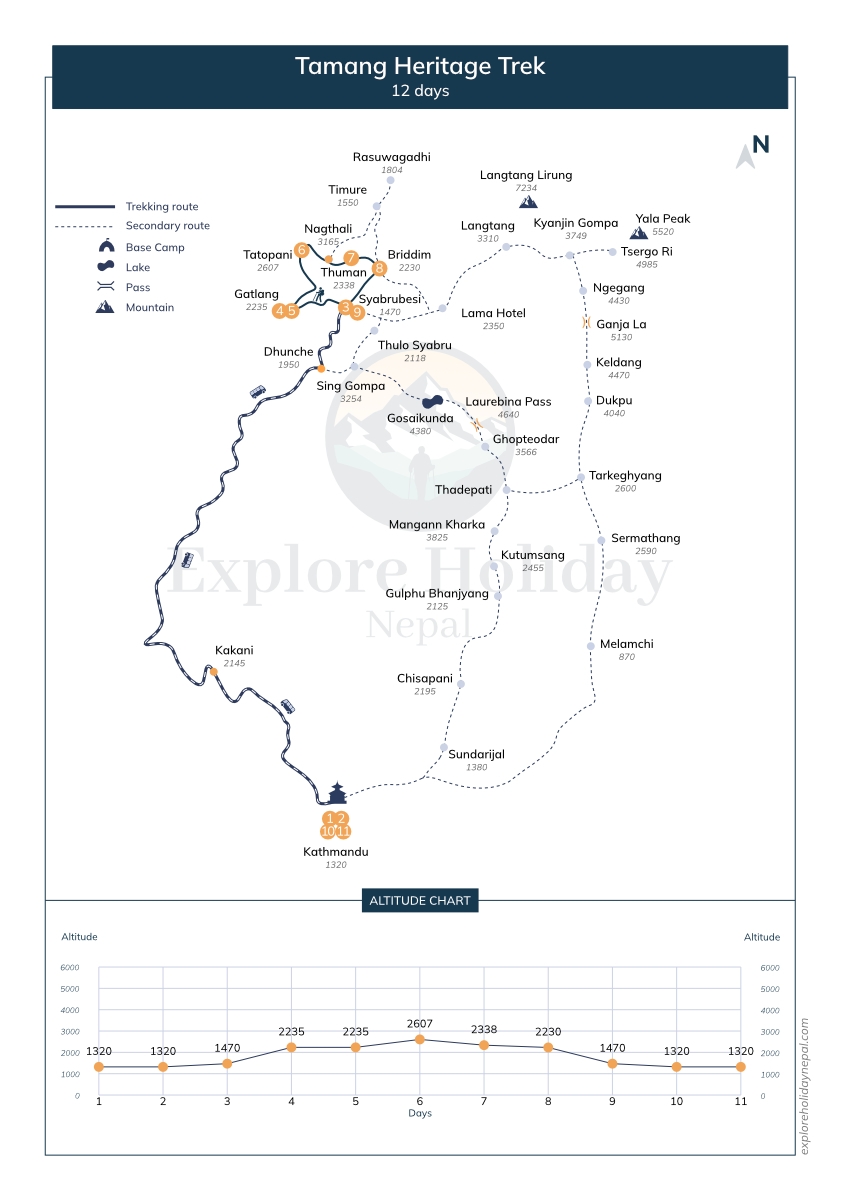
| Trip route | Kathmandu - Syabrubesi - Gatlang Village - Tatopani Village - Thuman/Nagethali - Briddim - Syabrubesi - Kathmandu |
| Cost | USD 770 per person |
Highlights
- Immerse yourself in the rich culture and traditions of the Tamang people, an ethnic group with a unique heritage.
- Visit authentic Tamang villages such as Gatlang, Thuman, and Briddim, experiencing traditional architecture and daily life.
- Stay in homestays with local Tamang families, gaining insights into their lifestyle, customs, and hospitality.
- Witness the vibrant Tamang dress, distinct from other Nepalese communities, and participate in local customs and festivals.
- Explore ancient monasteries along the trail, including the beautiful Nagthali Gompa.
- Enjoy panoramic views of the Langtang and Ganesh Himalayan ranges, providing a stunning backdrop to the trek.
- Trek through parts of Langtang National Park, home to diverse flora and fauna, and potentially spot wildlife like the red panda.
- Relax in the natural hot springs near Syabrubesi and Gatlang, offering a soothing break during the trek.
- Depending on the itinerary, the trek may offer distant views of the sacred Gosaikunda Lake.
- Climb to Nagthali Gompa for breathtaking panoramic views of the Langtang and Ganesh Himalayan ranges.
- Trek through diverse landscapes, including terraced fields, dense forests, and alpine meadows.
- Witness and participate in the traditional Tamang Syabru dance, a cultural performance passed down through generations.
- Explore local markets and purchase authentic Tamang handicrafts and souvenirs.
Overview
 Tamang Heritage Trek: Everything You Actually Need to Know
So you're looking at the Tamang Heritage Trek. Smart choice—though I'm probably biased because this trek completely won me over when I did it last year.
Here's the thing: most people heading to Nepal have heard about Everest Base Camp or the Annapurna Circuit. Those are the big names. The Tamang Heritage Trek? Not so much. But that's actually part of what makes it special. You get authentic cultural experiences without fighting crowds for guesthouse beds, and the mountains are just as impressive (just don't tell the EBC crowd I said that).
Let me break down what this trek actually involves, what it costs, what you'll see, and whether it's the right fit for you.
What Exactly Is This Trek?
The Tamang Heritage Trek takes you through traditional Tamang villages in the Langtang region, north of Kathmandu near the Tibet border. The Tamang people are one of Nepal's major ethnic groups with Tibetan roots—their language, culture, Buddhism, and architecture are all distinctly different from what you'll see in Kathmandu.
The trek typically takes 7-10 days depending on your route and how much time you spend in each village. You'll be walking through places like Gatlang, Tatopani, Thuman, and Briddim—villages where tourism exists but hasn't completely taken over yet. People still farm their terraced fields, monks still conduct daily prayers in centuries-old monasteries, and kids still look genuinely curious when they see foreigners walking through.
Maximum elevation is around 3,700m if you do the Lauribina La pass option (most people skip this). Otherwise you're staying between 2,000-2,500m, which means altitude sickness is way less of an issue compared to higher treks.
The Honest Truth About Difficulty
This trek is usually labeled "moderate" and that's pretty accurate. You don't need to be an athlete, but you can't be completely out of shape either.
Daily walking time ranges from 4-7 hours. Some days are mostly uphill (Syabrubesi to Gatlang will test your legs), some days are mostly downhill (which sounds easier but actually destroys your knees), and some days are a mix. The trails are generally well-maintained—rocky in places, muddy after rain, but nothing that requires technical climbing skills.
If you can comfortably hike 5-6 hours with a daypack at home, you can handle this trek. The elevation isn't high enough to cause serious problems for most people, though you might feel a bit breathless the first day or two.
What actually makes it challenging? The cumulative effect. By day five, your legs are tired, you've probably got a blister or two, and the novelty of dal bhat twice a day has worn off. But that's true of basically every multi-day trek.
Where You'll Actually Go
Syabrubesi (1,460m) - Starting point. Nothing special, just a trekking town with guesthouses and supplies. You'll spend one night here after the drive from Kathmandu.
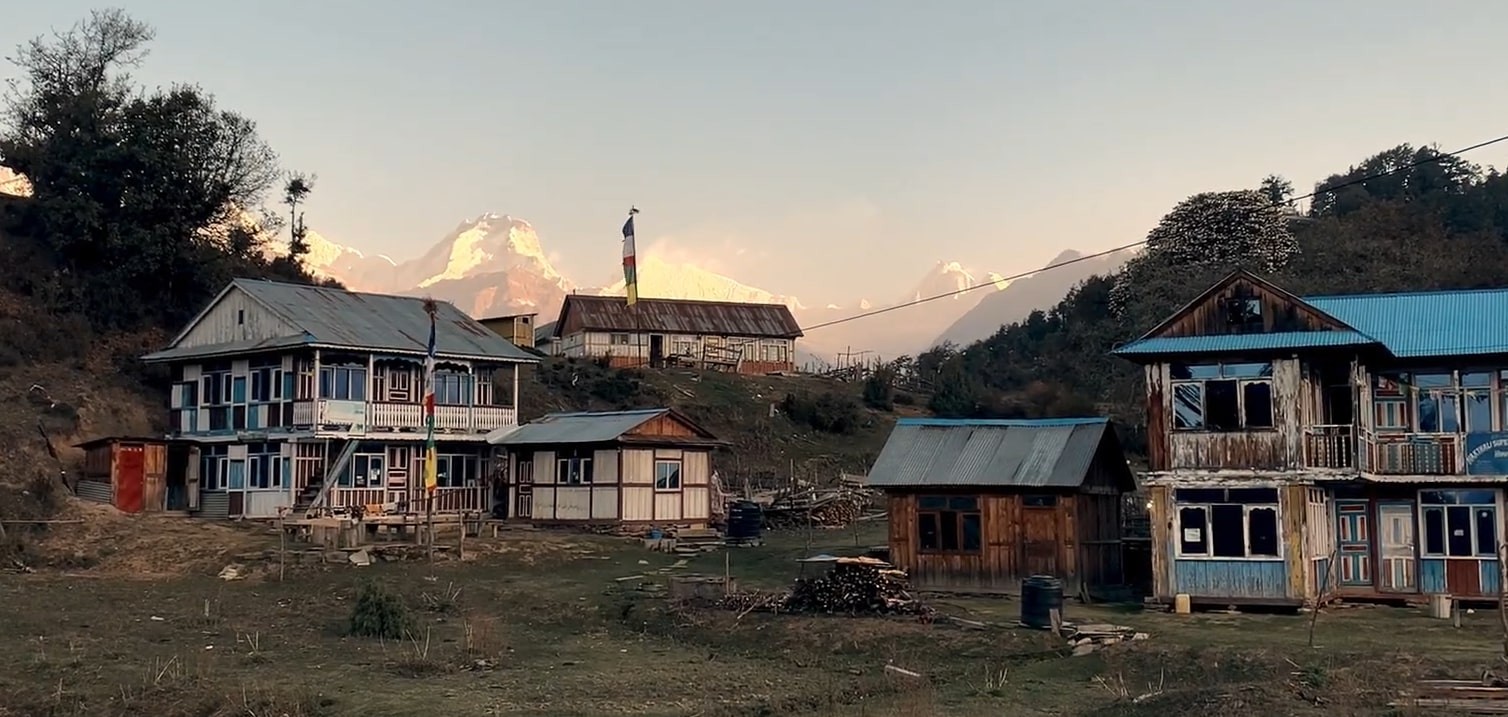
Gatlang (2,238m) - First major village. Has an old monastery, a sacred cave, and genuine Tamang character. This is where you'll probably have your first homestay experience. The gompa (monastery) here is worth visiting—the monk who runs it is super welcoming.
Tatopani (2,607m) - Famous for its hot springs, though "hot" is generous. They're more warm. Still feels amazing after hiking all day. The village is small, most people just come for the springs.
Thuman (2,338m) - Smaller than Gatlang but has a really beautiful monastery with well-preserved murals. Less touristy, more authentic daily village life happening around you.
Briddim (2,229m) - Probably the highlight for most trekkers. This village has the best-developed homestay program, incredible mountain views (Langtang Lirung dominates the skyline), and families who've been hosting trekkers long enough to make you feel genuinely welcome rather than like a transaction.
Some itineraries also include Nagthali viewpoint (3,165m) for sunrise mountain views, and you can connect to the main Langtang Valley trek if you have extra time.
Best Time to Go (Real Talk)
Spring (March-May) - This is prime time. Weather's stable, rhododendrons are blooming (absolutely gorgeous), temperatures are comfortable. Also the most crowded, though "crowded" here means you'll share a guesthouse with five other trekkers instead of having it to yourself.
Autumn (September-November) - Second best option. Clear skies, excellent mountain views, comfortable temperatures. October is peak season across all Nepal treks, so book ahead.
Winter (December-February) - Doable but cold, especially at night. You'll need a serious sleeping bag. Fewer trekkers means better cultural interaction and cheaper prices. Some high passes might have snow.
Monsoon (June-August) - Generally avoided, and for good reason. It rains a lot, trails get muddy and slippery, leeches appear in the forests, and mountain views are often cloud-covered. That said, the Langtang region is in a partial rain shadow, so it's not as bad as areas further south. If you don't mind rain and want serious solitude, it's possible.
I went in October. Weather was perfect except for one rainy afternoon, and there were enough other trekkers that I met people to chat with but never felt crowded.
The Cultural Experience Part
This is where the Tamang Heritage Trek separates itself from other Nepal treks. You're not just passing through villages—you're staying in people's homes.
Most nights you'll stay in homestays where families have converted upper floors into basic guest rooms. You'll eat meals with them (or at least in their kitchen), you'll see how they actually live, and if you make any effort at all to be friendly, they'll usually open up.
I learned to make momos from a grandmother in Gatlang. Helped harvest potatoes in Briddim. Attended a prayer ceremony at the Thuman monastery where I had absolutely no idea what was happening but it was beautiful anyway. These weren't arranged "cultural programs"—they were just normal life that happened to include me because I was there.
The Buddhism here is the Tibetan variety—you'll see prayer wheels, mani walls with carved mantras, colorful prayer flags everywhere, and gompas (monasteries) in most villages. The monks are generally happy to show you around if you're respectful (take off your shoes, don't touch things without asking, and for the love of god don't take photos during prayers unless you ask first).
Traditional Tamang houses are built from stone with wood trim, designed to withstand earthquakes (important in Nepal). Most families keep animals on the ground floor—yaks, cows, goats—and live above. The body heat from the animals helps warm the house in winter. Clever.
Food Situation
Let's be real: you're eating dal bhat twice a day. That's lentil soup with rice, usually served with some vegetable curry, pickle, and sometimes a papad (crispy lentil cracker). It's actually good, filling, and you get unlimited refills.
Other options in most villages: momos (dumplings), thukpa (noodle soup), fried rice, chow mein, tibetan bread with jam and honey for breakfast.
The food is fresh because it has to be—no refrigeration, everything's made daily. Portions are huge because trekkers need calories. And it's cheap (300-600 rupees per meal depending on the village and what you order).
Some villages now have yak cheese factories as a way to generate income. The cheese is... interesting. Kind of like aged cheddar but smokier? You can buy it to take with you. Makes good snacks on the trail.
Bring water purification tablets. The water from taps isn't reliably safe to drink, and buying bottled water gets expensive and creates plastic waste. Most guesthouses can provide boiled water if you ask.
What to Actually Pack
Essentials:
- Good hiking boots (broken in before you go—I can't stress this enough)
- Sleeping bag rated to at least -5°C (guesthouses provide blankets but it gets cold)
- Layers: base layers, fleece, down jacket, rain jacket
- Trekking pants (not jeans—they're terrible if they get wet)
- Sun protection: hat, sunglasses, sunscreen (mountain sun is intense)
- First aid kit with blister treatment (you will get blisters)
- Headlamp (villages have electricity but it's not always reliable)
- Water bottles or hydration system
- Toilet paper (many bathrooms don't provide it)
Nice to Have:
- Book or e-reader (evenings can be long)
- Cards or small games (good for meeting other trekkers)
- Hand sanitizer
- Your own soap/shampoo
- Earplugs (guesthouse walls are thin)
- Power bank (charging can be limited or expensive in villages)
Don't Bother:
- Fancy camera gear unless photography is your thing (phone cameras work fine)
- Lots of clothes (you'll wear the same stuff every day anyway)
- Hair dryer, straightener, etc. (there's not enough power)
- Guidebook (seriously, your guide or other trekkers will have all the info you need)
Pack light. Even with a porter, less stuff means more comfort.
Safety and Practical Concerns
Is it safe? Yeah, very. Nepal is generally safe for trekkers, and the Tamang Heritage Trail is no exception. Standard precautions apply (don't trek alone at night, watch your footing on steep sections, etc).
Cell phone service? Spotty. NTC (Nepal Telecom) has coverage in some villages but not everywhere. Don't count on reliable internet.
Emergencies? Most villages have basic health posts. Serious emergencies require helicopter evacuation to Kathmandu. This is why travel insurance with helicopter evacuation coverage is mandatory.
Altitude sickness? Unlikely at these elevations, but possible. Watch for headaches, nausea, dizziness. If symptoms are severe, descend immediately.
Bathrooms? Mix of squat toilets and western-style. Toilet paper not always provided. Showers range from "not available" to "cold bucket" to "solar-heated if you're lucky."
Women traveling solo? Generally safe. Nepali culture is conservative, so dress modestly (cover shoulders and knees). Homestays mean you're staying with families, which adds security.
What Makes This Trek Different
If you've read this far, you're probably wondering: should I do this trek or one of the more famous ones?
The Tamang Heritage Trek won't give you the bragging rights of Everest Base Camp. You won't see as many towering 8,000m peaks as the Annapurna Circuit. The trails aren't as developed, the guesthouses aren't as nice, and your Instagram photos probably won't get as many likes.
What you will get is genuine cultural immersion. Time in villages where tourism supplements traditional life but hasn't replaced it. Conversations with people whose lifestyle is radically different from yours. Monasteries where monks are actually praying, not just posing for photos. Meals shared with families in their kitchens. Mountain views that feel more intimate because you're not sharing them with 50 other people.
You'll also be directly supporting communities that were devastated by the 2015 earthquake and have rebuilt with tourism as part of their recovery strategy. Your money goes straight to families, not international hotel chains.
This trek works well if you have 10-14 days total in Nepal (including Kathmandu time), want something less strenuous than the big altitude treks, value culture as much as scenery, and prefer fewer crowds.
It's not the right choice if you want luxury teahouses, guaranteed hot showers, extensive menu options, strong wifi, or the ability to say you've done one of the "classic" Nepal treks.
For me? I'd take the Tamang Heritage Trek over EBC any day. But I'm the kind of traveler who'd rather share tea with a family than take photos at a famous landmark. You have to know what you want.
Real Expectations vs. Instagram Reality
Let me be straight with you about a few things:
The hot springs at Tatopani are not luxurious spa pools. They're concrete tanks filled with warm water, often shared with a dozen other people.
Homestays are not boutique hotels. You're sleeping on thin mattresses with shared bathrooms and no heating. It's basic.
Mountain views are weather-dependent. Clouds happen. You might not get those perfect sunrise shots of Langtang Lirung.
Cultural experiences can feel awkward. There's a language barrier, you might not understand what's happening, and sometimes you'll feel like you're intruding on people's lives (even though they've invited you).
The food is repetitive. Dal bhat is good, but it's still dal bhat for the tenth time.
But here's the thing—all of that is part of what makes it real. This isn't a sanitized tourism experience designed for comfort. It's actual villages where actual people live, and they're sharing their space with you. That comes with rough edges, and those rough edges are what make it memorable.
If you can embrace the discomfort, laugh at the awkward moments, appreciate the simplicity, and stay curious about the cultural differences, you'll have an amazing time.
If you need everything to be comfortable and predictable and Instagram-perfect, maybe look at other options.
Final Thoughts
The Tamang Heritage Trek isn't trying to compete with Everest or Annapurna. It's doing its own thing—combining moderate mountain trekking with deep cultural immersion in a region that's still finding its footing after the earthquake.
It's the right trek for people who care as much about the journey and the people as they do about the destination and the views. For travelers who value authenticity over comfort, conversation over luxury, and experience over achievement.
The mountains are beautiful, the culture is fascinating, the people are welcoming, and the whole thing will cost you less than most treks in Nepal.
Just bring good boots, an open mind, and realistic expectations. The rest will take care of itself.
Top Blogs About Trekking in the Langtang Region:
Uncover the best blogs about trekking in the Langtang region, featuring expert advice, detailed itineraries, personal experiences, and essential tips for adventurers looking to explore the Himalayas.
Altitude Sickness on Nepal Treks: Symptoms, Treatment, and When to Descend (Complete Guide)
Nepal Trekking Permits: Costs, Types, and How to Get Them
Nepal Trekking: What’s the Best Time to Go?
Budget Trekking in Nepal: Tips, Trails, and Tricks
Exploring Nepal’s Wildlife and Nature
Trekking Through Nepal: A Journey into the Himalayas
Top 10 Mountain Peaks in Nepal
Monastery Life in Nepal: Finding Peace in the Heart of the Himalayas
Trip Preparation
- Thermal underwear (top and bottom)
- Moisture-wicking t-shirts (long-sleeved)
- Moisture-wicking underwear
- Fleece jacket or pullover
- Insulated down or synthetic jacket
- Waterproof, windproof jacket (Gore-Tex or similar)
- Waterproof, windproof pants (Gore-Tex or similar)
- Warm beanie or hat
- Sun hat or cap
- Neck gaiter or scarf
- Trekking pants (convertible preferred)
- Waterproof trousers
- Lightweight gloves (inner)
- Insulated gloves or mittens (outer)
- Hiking boots (broken in and waterproof)
- Comfortable camp shoes (e.g., sneakers or sandals)
- Trekking backpack (30-40 liters) with waterproof cover
- Sleeping bag (rated for cold temperatures)
- Sleeping pad or mattress (insulated)
- Adjustable trekking poles
- Insulated water bottles or hydration bladder (2 liters capacity)
- Travel-sized toiletries
- Biodegradable soap
- Quick-dry towel
- Medications for altitude sickness, pain relief, and common ailments
- Sun protection cream, wet wipes, and hand sanitizer
- Camera and batteries
- Notebook and pen
- Earplugs (for sleeping in lodges)
- Portable solar charger
- Headlamp, power bank, and extra batteries
Trip Itinerary
Day 1 : Arrival in Kathmandu 1,320 m and transfer to hotel.
Welcome to Nepal! When you land at Tribhuvan International Airport, our representative will be waiting with your name on a sign (usually right outside the arrival gate). They'll help you navigate the chaos of Kathmandu traffic and get you to your hotel in Thamel, the main tourist district.First day is pretty straightforward—check in, maybe grab some momo dumplings from a nearby restaurant, and crash. Jet lag is real, especially if you're coming from Europe or the Americas. Don't try to do too much. Walk around Thamel if you're feeling energetic, but honestly just resting is fine.We'll have a quick trip briefing in the evening (around 6pm usually) where your guide will go over the trek details, check your gear, and answer questions. This is when you'll sort out any last-minute equipment you might need to rent or buy. Sleeping bag, trekking poles, down jacket—Thamel has everything and it's way cheaper than back home.
Day 2 : Drive to Syabrubesi 1,470 m via Dhunche town 1,950 - 06 hrs
Early start today—like 7am early. You'll grab breakfast at the hotel then pile into a jeep or local bus heading north. The drive is long (about 122km) but scenic once you get out of Kathmandu's urban sprawl.First few hours you're on the Pasang Lhamu Highway heading toward Tibet. The road winds through terraced hillsides, small towns, and alongside rivers. You'll pass through Trishuli Bazaar around midmorning—good place for a tea break and bathroom stop. After that, the road gets narrower and more adventurous (translation: a bit scary if you're afraid of heights).Lunch stop is usually in Dhunche (1,950m), the district headquarters. The town's bigger than you'd expect, with shops, guesthouses, and restaurants serving dal bhat and chow mein. This is also where you'll officially enter Langtang National Park and show your permits.The final hour to Syabrubesi gets really pretty—pine forests, mountain views, and the Bhote Koshi river rushing below. Syabrubesi itself is a typical trekking village, one main street with guesthouses and shops. Check in, stretch your legs, and get ready to actually start hiking tomorrow.Accommodation: Basic guesthouse in Syabrubesi
Meals: Breakfast, lunch, dinner included
Drive time: 7-8 hours depending on traffic and road conditions
Day 3 : Trek to Gatlang village 2,235 m - 05 hrs.
First actual trekking day! You'll start around 8am after breakfast. The trail immediately goes uphill (welcome to Nepal trekking), climbing steadily through terraced farmlands and small settlements. Locals will be working their fields—you might see them planting, harvesting, or just moving supplies up and down the mountain using those incredible basket systems.
After about 2 hours, you'll reach Grang village where there's usually a tea break. From here the trail continues upward through rhododendron and oak forests. If you're trekking in spring (March-May), the rhododendrons are blooming and it's absolutely stunning—reds, pinks, and whites everywhere.
The final push to Gatlang is the steepest part, but you'll be rewarded with your first proper Tamang village experience. Gatlang sits on a hillside with stone houses, narrow lanes, and incredible mountain views. The village has maybe 50-60 households, almost all Tamang families who've been here for generations.
Check into your homestay (you're staying with a local family tonight), wash up, and then your host will serve dinner—probably dal bhat with homegrown vegetables and maybe some yak cheese. After dinner, if you're not too tired, walk up to the village gompa (monastery) for sunset views. The light hitting the mountains is unreal.
Day 4 : A free day at Gatlang for exploration.
This is your buffer day to actually experience Gatlang instead of just passing through. No early wake-up today—sleep in if you want (though the roosters might have other plans).
After breakfast, visit the Gatlang Monastery properly. It's old (like 300+ years) and has some beautiful murals and statues inside. The monk there, if he's around, usually gives informal tours. Remember to walk clockwise around the monastery and prayer wheels—it's Buddhist tradition.
Behind the monastery is a trail leading to Parvati Kund, a sacred lake about an hour's walk uphill. Some people do this, others skip it. The lake itself is small but the views are worth it if you've got the energy. There's also a cave associated with Guru Rinpoche (Padmasambhava) that pilgrims visit.
Afternoon is good for just wandering the village, watching daily life happen around you. Women weaving carpets, kids playing, people working their fields. Your homestay family might invite you to help with something—making butter tea, preparing food, feeding animals. These unplanned moments are often the best part.
If there's a cultural program organized (usually in peak season), you'll see traditional Tamang dances and music in the evening. If not, just a relaxed dinner and early bed. Tomorrow's a solid trekking day.
Day 5 : Trek to Tatopani village 2, 607 m - 04 hrs.
Today's trek takes you from Gatlang down into a valley and then back up to Tatopani. It's one of the longer days, so start early—around 7:30am after breakfast.
The trail descends first through forests and terraced fields, dropping down to the Bhote Koshi river at around 1,800m. This is where your knees will remind you that downhill isn't easier, just different. There's a suspension bridge crossing the river—these always feel sketchy but they're safe, just hold the sides and don't look down if heights bother you.
After crossing, it's uphill to Tatopani. The climb is steady but not killer, winding through forest where you might see langur monkeys swinging through the trees. The forest here is thick rhododendron and oak, with occasional clearings offering mountain views.
You'll reach Tatopani around 2-3pm depending on your pace. Tatopani literally means "hot water" and the village is famous for its natural hot springs. After you check in and drop your bags, head straight to the springs—they're about 5 minutes walk from the main village, right by the river.
The hot springs are basically concrete pools fed by natural thermal water. The water is warm (not scalding hot, just nice), and after 6-7 hours of trekking, soaking your tired legs feels incredible. Locals believe the water has healing properties for skin and joint problems. Bring a towel and maybe some soap—you can basically bathe there.
Day 6 : Trek to Thuman 2,338 m via Nagethali 3,165 m, Bumthang- 06 hrs.
Longest day of the trek, so pack some snacks and mentally prepare. You're hiking to Thuman but going the scenic route via Nagethali viewpoint (3,165m), which adds distance but the views are worth it.
Start around 7am. The trail climbs steadily from Tatopani, switchbacking up through rhododendron forest. After about 3 hours of uphill, you'll reach Nagethali—a small clearing with a basic teahouse and absolutely massive mountain views. On a clear day you can see Langtang Lirung (7,227m), Ganesh Himal range, and into Tibet. This is your lunch stop. Order dal bhat or noodle soup, rest your legs, and soak in the panorama.
From Nagethali, the trail continues along ridgelines with up-and-down sections, passing through Brimdang village (tiny settlement, just a few houses). The final stretch to Thuman involves descending through forests and farmland, eventually dropping into the village around 3-4pm.
Thuman is smaller than Gatlang, maybe 30-40 houses, but it has a beautiful monastery that's definitely worth visiting before dinner. The gompa here has remarkably well-preserved murals from the 1700s—the monk there (Lama Dorje when I went) gives tours and explains the different Buddha figures and mandalas. Fascinating stuff even if you're not religious.
Homestay tonight, another Tamang family opening their home. Dinner, probably some raksi (local millet alcohol) if you're brave enough to try it, and sleep.
Day 7 : Trek to Briddim 2,230 m - 06 hrs.
Shorter day today, which is nice after yesterday's marathon. The trail from Thuman to Briddim winds through forests and farmland, mostly on a gradual traverse without major elevation changes.
You'll start around 8am, descending from Thuman through terraced fields where families are usually working—planting potatoes, harvesting crops, tending to their yaks and dzos. The trail passes through Lingling village after about 90 minutes, where there's a tea shop if you want a break.
The scenery today is more about cultural immersion than dramatic mountains. You're walking through lived-in landscapes where agriculture has shaped every hillside into terraces going back hundreds of years. People have figured out how to grow food on slopes that seem impossibly steep.
Arrive in Briddim around lunch time. Briddim is the biggest village on the trek and has the most developed community-based tourism program. The homestay network here is well-organized—families rotate hosting trekkers so income gets distributed fairly across the community. Smart system.
Your homestay hosts will probably be experienced with trekkers, speaking decent English and knowing what tourists typically want. After lunch, you've got free time. Some people hike up to the gompa above the village for sunset mountain views (Langtang Lirung dominates the northern horizon). Others just relax, play cards, chat with their hosts, or explore the village streets.
In the evening there's sometimes a cultural program at the community center (500 rupees usually)—traditional Tamang dancing and music. If that's not happening, just a normal homestay dinner and conversation with your hosts about village life, changes they've seen, earthquake recovery, whatever topics come up.
Day 8 : Trek to Syabrubesi - 04 hrs.
Last day of trekking! Mostly downhill from Briddim back to where you started, retracing some of your route but also seeing things from a different angle.
The morning starts with views from Briddim—if it's clear, take some final photos of Langtang Lirung because you won't see these mountains again on this trip. After breakfast, say goodbye to your homestay family (tipping is customary if they treated you well), and start descending.
The trail drops down through forests, past small settlements, crossing streams, and eventually rejoining the main Langtang Valley trail. You'll see more trekkers on this section heading up valley to Langtang or Kyanjin Gompa—the main valley trek is more popular than the Tamang Heritage circuit.
Around midday you'll reach Syabrubesi, completing the loop. Same town you started from but somehow it feels different now—you've actually done the trek, met the families, seen the villages, walked the trails. Check into a guesthouse (not a homestay tonight—you get a real bed and hot shower).
Afternoon is yours. Some people wash clothes, charge devices, catch up on WiFi stuff. Others just rest. There's a small market in Syabrubesi if you want to buy souvenirs or supplies. Dinner is usually at the guesthouse—one last dal bhat for the road, or maybe treat yourself to a pizza or burger if they have it.
Day 9 : Drive to Kathmandu and transfer to your hotels - 06 hrs.
Back to civilization day. Wake up without an alarm (finally), have a leisurely breakfast, and then load into the jeep for the drive back to Kathmandu. Same route you took to get here but somehow the drive back always feels longer.
The road conditions might have changed since you drove up—monsoon damage, landslides, or construction can affect timing. Usually it takes 7-8 hours with stops for tea and lunch, but could be longer if there are delays. Bring something to read or download some podcasts because you'll be sitting for a while.
You'll stop in Dhunche or Trishuli for lunch (same places as before). The final 2-3 hours into Kathmandu is mostly highway driving until you hit city traffic, then it's the usual chaotic Kathmandu crawl to get to your hotel in Thamel.
Arrive in Kathmandu late afternoon or early evening. Check into your hotel, shower off a week of trekking grime, and decide if you want to celebrate with a nice dinner somewhere. Thamel has everything—western food, Asian cuisine, rooftop bars, live music places. Or just order room service and crash. You've earned it.
Day 10 : Departure
Last day in Nepal. Your flight time determines everything today. If you're flying out in the evening, you've got most of the day to explore Kathmandu—hit up Durbar Square, Swayambhunath (Monkey Temple), or Boudhanath Stupa. Or shop for last-minute souvenirs in Thamel (singing bowls, prayer flags, trekking gear, pashmina scarves, whatever).
If your flight is morning or midday, you'll probably just have breakfast and head to the airport. Our representative will transfer you in plenty of time—international flights require being there 3 hours early, so factor that in.
Tribhuvan International Airport is small but can be chaotic. Check-in lines get long, security is thorough (expect bag searches), and the departure hall is basically one big duty-free shop. Grab some Himalayan coffee or tea as last-minute gifts if you forgot to buy souvenirs.
And that's it. Ten days from landing in Kathmandu to leaving. The trek is over, but you'll have photos, memories, and probably a newfound appreciation for hot showers and not eating dal bhat twice a day. Safe travels home.
- 1 - 1 pax US$ 900
- 2 - 5 pax US$ 770
- 6 - 9 pax US$ 755
- 10 - 15 pax US$ 740
- 16 - 20 pax US$ 725
Inclusions
What is included?
- All arrival and departure transportation from the airport to hotel and vice versa.
- Accommodation in a hotel in Kathmandu with breakfast included.
- A guided tour of Kathmandu.
- All necessary permits for trekking
- Full board during the trek, which means meals (breakfast, lunch, and dinner).
- The trek includes a guide and porters, who will receive daily wages, meals, accommodation, transportation allowance, and medical insurance (only for field staff/porters).
- A group dinner upon arrival or departure, with a briefing about the trek.
- A comprehensive medical kit carried by our guide during the entire trek.
- Private vehicles for sightseeing tours based on the group size, accompanied by a city guide.
What isn't included?
- Nepal visa and medical/travel insurance are not included.
- Meals in Kathmandu and personal expenses like laundry are not covered.
- If you prefer a single room in Kathmandu or during treks (where available), there's an additional cost.
- Emergency evacuation, whether by any means of transportation or helicopter service, is an extra expense.
- You need to bring your personal trek gear, including sleeping bags, duvet/down jackets, and kit/duffel bags.
- Additional snacks, refreshments, and drinking water are at your own cost.
- If you have to return early from the trek due to personal reasons or sickness, you'll need to cover the extra expenses yourself (can be claimed from your insurance).
- Bring a personal medical kit based on your doctor's advice.
Complimentary
Booking Terms and Conditions
Booking, Cancellation, and Refund Policy
Transportation
Trip and the Weather
Tamang Heritage Trek Starting and Ending Points
Major Trips for Tamang Heritage Trek
Best Time for Tamang Heritage Trek
Tamang Heritage Trekking Difficulty
Food and Accommodation
Communication and Networking
Explore Holiday Treks Team for Tamang Heritage Trek
Important Note
Why with Explore Holiday Treks